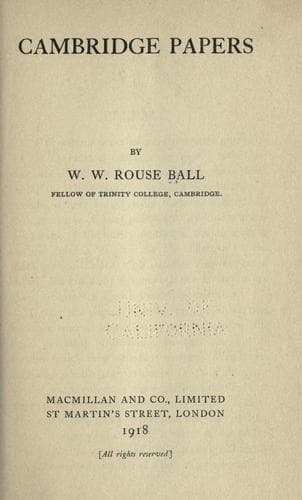
Cambridge PapersBall, W. W. Rouse (Walter William Rouse)
History
Cambridge Papers
Ball, W. W. Rouse (Walter William Rouse)
Trinity College (University of Cambridge); University of Cambridge -- History
Jebb's statement about the number of wranglers and senior optimes is
only approximate.
It may be added that it was now frankly recognized that the
examination was competitive[45]. Also that though it was open to any
member of the senate to take part in it, yet the determination of the
relative merit of the students was entirely in the hands of the
moderators[46]. Although the examination did not occupy more than
three days it must have been a severe physical trial to anyone who was
delicate. It was held in winter and in the senate-house: that building
was then noted for its draughts, and was not warmed in any way; and,
according to tradition, on one occasion the candidates on entering in
the morning found the ink frozen in the pots on their desks.
The University was not altogether satisfied[47] with the regulations,
and in 1779[48] the scheme of examination was amended in various
respects. In particular the examination was extended to four days,
a third day being given up entirely to natural religion, moral
philosophy, and Locke's _Essay_. It was further announced[49] that a
candidate would not receive credit for advanced subjects unless he had
satisfied the examiners in Euclid's _Elements_ and elementary natural
philosophy.
A system of brackets or "classes quam minimae" was now introduced.
Under this system the examiners issued on the morning of the fourth
day a provisional list of men who had obtained honours, with the names
of those of about equal merit bracketed, and that day was devoted to
arranging the names in each bracket in order of merit: the examiners
being given explicit authority to invite the assistance of others in
this work. Whether at this time a candidate could request to be
re-examined with the view of being moved from one bracket to another
is uncertain, but later this also was allowed.
The number of examiners was also increased to four, the moderators of
one year becoming, as a matter of course, the examiners of the next.
Thus of the four examiners in each year, two had taken part in the
examination of the previous year, and the continuity of the system of
examination was maintained. The names of the moderators appear on the
tripos lists, but the names of the examiners were not printed on the
lists till some years later.
The right of any master of arts to take part in the examination was
not affected, though henceforth it was exercised more sparingly, and I
believe was not insisted on after 1785. But it became a regular custom
for the moderators to invite particular residents to examine and
compare specified candidates: Milner, of Queens', was constantly asked
to assist in this way.
Public-domain text, read in full here on John Shaqi.
Reviews
Reviews
No reviews yet
Be the first to share your thoughts on this work.
Elsewhere in the archive
Join the Discussion
Join the discussion
Sign in to leave a comment or review.
Sign InorCreate an account