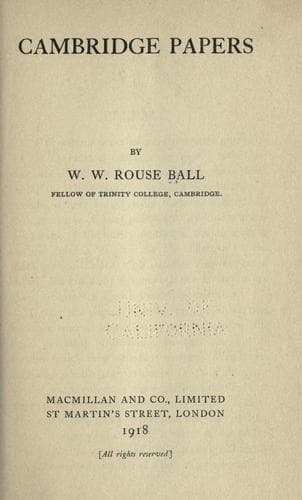
Cambridge PapersBall, W. W. Rouse (Walter William Rouse)
History
Cambridge Papers
Ball, W. W. Rouse (Walter William Rouse)
Trinity College (University of Cambridge); University of Cambridge -- History
On the Monday morning, a little before eight o'clock, the students,
generally about a hundred, enter the Senate-House, preceded by a
master of arts, who on this occasion is styled the father of the
College to which he belongs. On two pillars at the entrance of the
Senate-House are hung the classes and a paper denoting the hours of
examination of those who are thought most competent to contend for
honours. Immediately after the University clock has struck eight,
the names are called over, and the absentees, being marked, are
subject to certain fines. The classes to be examined are called
out, and proceed to their appointed tables, where they find pens,
ink, and paper provided in great abundance. In this manner, with the
utmost order and regularity, two-thirds of the young men are set to
work within less than five minutes after the clock has struck eight.
There are three chief tables, at which six examiners preside. At the
first, the senior moderator of the present year and the junior
moderator of the preceding year. At the second, the junior moderator
of the present, and the senior moderator of the preceding year. At
the third, two moderators of the year previous to the two last, or
two examiners appointed by the Senate. The two first tables are
chiefly allotted to the six first classes; the third, or largest, to
the οἱ πολλοί.
The young men hear the propositions or questions delivered by the
examiners; they instantly apply themselves; demonstrate, prove, work
out and write down, fairly and legibly (otherwise their labour is of
little avail) the answers required. All is silence; nothing heard
save the voice of the examiners; or the gentle request of some one,
who may wish a repetition of the enunciation. It requires every
person to use the utmost dispatch; for as soon as ever the examiners
perceive anyone to have finished his paper and subscribed his name
to it another question is immediately given....
The examiners are not seated, but keep moving round the tables, both
to judge how matters proceed and to deliver their questions at
proper intervals. The examination, which embraces arithmetic,
algebra, fluxions, the doctrine of infinitesimals and increments,
geometry, trigonometry, mechanics, hydrostatics, optics, and
astronomy, in all their various gradations, is varied according to
circumstances: no one can anticipate a question, for in the course
of five minutes he may be dragged from Euclid to Newton, from the
humble arithmetic of Bonnycastle to the abstruse analytics of
Waring. While this examination is proceeding at the three tables
between the hours of eight and nine, printed problems are delivered
to each person of the first and second classes; these he takes with
him to any window he pleases, where there are pens, ink, and paper
prepared for his operations.
Public-domain text, read in full here on John Shaqi.
Reviews
Reviews
No reviews yet
Be the first to share your thoughts on this work.
Elsewhere in the archive
Join the Discussion
Join the discussion
Sign in to leave a comment or review.
Sign InorCreate an account