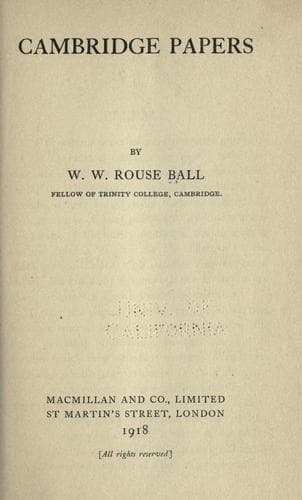
Cambridge PapersBall, W. W. Rouse (Walter William Rouse)
History
Cambridge Papers
Ball, W. W. Rouse (Walter William Rouse)
Trinity College (University of Cambridge); University of Cambridge -- History
The examination began at eight o'clock in the morning. At nine the
papers had to be given up, and half-an-hour was allowed for breakfast.
At half-past nine the candidates came back, and were examined in the
way described above till eleven, when the senate-house was again
cleared. An interval of two hours then took place. At one o'clock all
returned to be again examined. At three the senate-house was cleared
for half-an-hour, and, on the return of the candidates, the
examination was continued till five. At seven in the evening the first
four classes went to the senior moderator's rooms to solve problems.
They were finally dismissed for the day at nine, after eight hours of
examination. The work of Tuesday was similar to that of Monday:
Wednesday was partly devoted to logic and moral philosophy.
At eight o'clock on Thursday morning a first list was published with
all candidates of about equal merits bracketed. Until nine o'clock a
candidate had the right to challenge anyone above him to an
examination to see which was the better. At nine a second list came
out, and a candidate's right of challenge was then confined to the
bracket immediately above his own. If he proved himself the equal of
or better than the man so challenged his name was transferred to the
upper bracket. To challenge and then to fail to substantiate the claim
to removal to a higher bracket was considered rather ridiculous.
Revised lists were published at eleven, three, and five, according to
the results of the examination during that day. At five the whole
examination ended. The proctors, moderators, and examiners then
retired to a room under the public library to prepare the list of
honours, which was sometimes settled in a few hours, but sometimes not
before two or three the next morning. The name of the senior wrangler
was generally announced at midnight, and the rest of the list the next
morning. In 1802 there were eighty-six candidates for honours, and
they were divided into fifteen brackets, the first and second brackets
containing each one name only, and the third bracket four names.
It is clear from the above account that the competition fostered by
the examination had developed so much as to threaten to impair its
usefulness as guiding the studies of the men. On the other hand, there
can be no doubt that the carefully devised arrangements for obtaining
an accurate order of merit stimulated the best men to throw all their
energies into the work for the examination. It is easy to point out
the double-edged result of a strict order of merit. The problem before
the University was to retain its advantages while checking any abuses
to which it might lead.
Public-domain text, read in full here on John Shaqi.
Reviews
Reviews
No reviews yet
Be the first to share your thoughts on this work.
Elsewhere in the archive
Join the Discussion
Join the discussion
Sign in to leave a comment or review.
Sign InorCreate an account