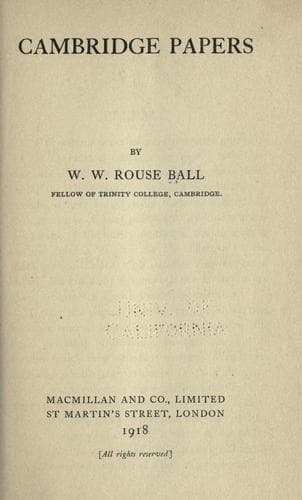
Cambridge PapersBall, W. W. Rouse (Walter William Rouse)
History
Cambridge Papers
Ball, W. W. Rouse (Walter William Rouse)
Trinity College (University of Cambridge); University of Cambridge -- History
It was the privilege of the moderators to entertain the proctors and
some of the leading resident mathematicians the night before the issue
of the final list, and to communicate that list in confidence to their
guests. This pleasant custom survived till 1884. I revived the
practice in 1890 when acting as senior moderator, but it seems to have
now ceased.
In 1806 Sir Frederick Pollock was senior wrangler, and in 1869 in
answer to an appeal from De Morgan for an account of the mathematical
study of men at the beginning of the century he wrote a letter[58]
which is sufficiently interesting to bear reproduction:
I shall write in answer to your inquiry, _all_ about my books,
my study, and my degree, and leave you to settle all about the
proprieties which my letter may give rise to, as to egotism,
modesty, &c. The only books I read the first year were Wood's
_Algebra_ (as far as quadratic equations), Bonnycastle's ditto,
and _Euclid_ (Simpson's). In the second year I read Wood (beyond
quadratic equations), and Wood and Vince, for what they called the
_branches_. In the third year I read the _Jesuit's_ Newton and
Vince's _Fluxions_; these were all the _books_, but there were
certain MSS. floating about which I copied--which belonged to
Dealtry, second wrangler in Kempthorne's year. I have no doubt that
I had read less and seen fewer books than any senior wrangler of
about my time, or any period since; but what I knew I knew
thoroughly, and it was completely at my fingers' ends. I consider
that I was the last _geometrical_ and _fluxional_ senior wrangler;
I was not up to the _differential_ calculus, and never acquired it.
I went up to college with a knowledge of Euclid and algebra to
quadratic equations, nothing more; and I never read any second
year's lore during my first year, nor any third year's lore during
my second; my _forte_ was, that what I _did_ know I _could produce
at any moment with PERFECT accuracy_. I could repeat the first book
of Euclid word by word and letter by letter. During my first year
I was not a "_reading_" man (so called); I had no expectation of
honours or a fellowship, and I attended all the lectures on all
subjects--Harwood's anatomical, Wollaston's chemical, and Farish's
mechanical lectures--but the examination at the end of the first
year revealed to me my powers. I was not only in the first class,
but it was generally understood I was _first_ in the first class;
neither I nor anyone for me expected I should get in at all. Now, as
I had taken no pains to prepare (taking, however, marvellous pains
while the examination was going on), I knew better than anyone else
the value of my _examination qualities_ (great rapidity and perfect
accuracy); and I said to myself, "If you're not an ass, you'll be
senior wrangler"; and _I took to "reading" accordingly_. A curious
circumstance occurred when the Brackets came out in the Senate-house
Public-domain text, read in full here on John Shaqi.
Reviews
Reviews
No reviews yet
Be the first to share your thoughts on this work.
Elsewhere in the archive
Join the Discussion
Join the discussion
Sign in to leave a comment or review.
Sign InorCreate an account