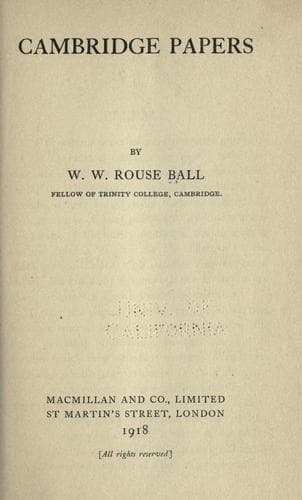
Cambridge PapersBall, W. W. Rouse (Walter William Rouse)
History
Cambridge Papers
Ball, W. W. Rouse (Walter William Rouse)
Trinity College (University of Cambridge); University of Cambridge -- History
In 1817 Peacock, who was moderator, introduced the symbols for
differentiation into the papers set in the senate-house examination;
his colleague, however, continued to use the fluxional notation.
Peacock himself wrote on 17 March 1817 (_i.e._ shortly after the
examination) on the subject as follows[63]:
I assure you ... that I shall never cease to exert myself to the
utmost in the cause of reform, and that I will never decline any
office which may increase my power to effect it. I am nearly certain
of being nominated to the office of Moderator in the year 1818-19,
and as I am an examiner in virtue of my office, for the next year I
shall pursue a course even more decided than hitherto, since I shall
feel that men have been prepared for the change, and will then be
enabled to have acquired a better system by the publication of
improved elementary books. I have considerable influence as a
lecturer, and I will not neglect it. It is by silent perseverance
only that we can hope to reduce the many-headed monster of
prejudice, and make the University answer her character as the
loving mother of good learning and science.
In 1818 all candidates for honours, that is, all men in the first six
preliminary classes, were allowed to attempt the problems: this change
was made by the moderators.
In 1819 Peacock, who was again moderator, induced his colleague to
adopt the new notation. It was employed in the next year by Whewell,
and in the following year by Peacock again. Henceforth the calculus
in its modern language and analytical methods were freely used, new
subjects were introduced, and for many years the examination provided
a mathematical training fairly abreast of the times.
By this time the disputations had ceased to have any immediate effect
on a man's place in the tripos. Thus Whewell[64], writing about his
duties as moderator in 1820, said:
You would get very exaggerated ideas of the importance attached to
it [an Act] if you were to trust Cumberland; I believe it was
formerly more thought of than it is now. It does not, at least
immediately, produce any effect on a man's place in the tripos, and
is therefore considerably less attended to than used to be the case,
and in most years is not very interesting after the five or six best
men: so that I look for a considerable exercise of, or rather demand
for, patience on my part. The other part of my duty in the Senate
House consists in manufacturing wranglers, senior optimes, etc. and
is, while it lasts, very laborious.
Of the examination itself in this year he wrote as follows[65]:
Public-domain text, read in full here on John Shaqi.
Reviews
Reviews
No reviews yet
Be the first to share your thoughts on this work.
Elsewhere in the archive
Join the Discussion
Join the discussion
Sign in to leave a comment or review.
Sign InorCreate an account