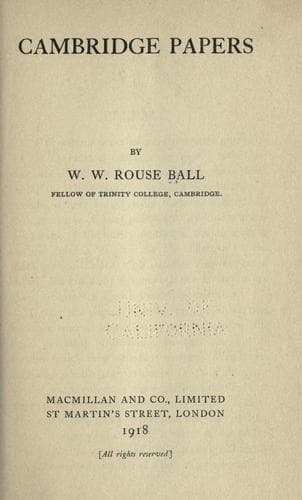
Cambridge PapersBall, W. W. Rouse (Walter William Rouse)
History
Cambridge Papers
Ball, W. W. Rouse (Walter William Rouse)
Trinity College (University of Cambridge); University of Cambridge -- History
The examination in the Senate House begins to-morrow, and is rather
close work while it lasts. We are employed from seven in the morning
till five in the evening in giving out questions and receiving
written answers to them; and when that is over, we have to read over
all the papers which we have received in the course of the day, to
determine who have done best, which is a business that in numerous
years has often kept the examiners up the half of every night; but
this year is not particularly numerous. In addition to all this, the
examination is conducted in a building which happens to be a very
beautiful one, with a marble floor and a highly ornamented ceiling;
and as it is on the model of a Grecian temple, and as temples had no
chimneys, and as a stove or a fire of any kind might disfigure the
building, we are obliged to take the weather as it happens to be,
and when it is cold we have the full benefit of it--which is likely
to be the case this year. However, it is only a few days, and we
have done with it.
A sketch of the examination in the previous year from the point of
view of an examinee was given by J.M.F. Wright[66], but there is
nothing of special interest in it.
Sir George B. Airy[67] gave the following sketch of his recollections
of the reading and studies of undergraduates of his time and of the
tripos of 1823, in which he had been senior wrangler:
At length arrived the Monday morning on which the examination for
the B.A. degree was to begin.... We were all marched in a body to
the Senate-House and placed in the hands of the Moderators. How the
"candidates for honours" were separated from the οἱ πολλοί I do not
know, I presume that the Acts and the Opponencies had something to
do with it. The honour candidates were divided into six groups: and
of these Nos. 1 and 2 (united), Nos. 3 and 4 (united), and Nos. 5
and 6 (united), received the questions of one Moderator. No. 1,
Nos. 2 and 3 (united), Nos. 4 and 5 (united), and No. 6, received
those of the other Moderator. The Moderators were reversed on
alternate days. There were no printed question-papers: each examiner
had his bound manuscript of questions, and he read out his first
question; each of the examinees who thought himself able proceeded
to write out his answer, and then orally called out "Done." The
Moderator, as soon as he thought proper, proceeded with another
question. I think there was only one course of questions on each day
(terminating before 3 o'clock, for the Hall dinner). The examination
continued to Friday mid-day. On Saturday morning, about 8 o'clock,
the list of honours (manuscript) was nailed on the door of the
Senate House.
Public-domain text, read in full here on John Shaqi.
Reviews
Reviews
No reviews yet
Be the first to share your thoughts on this work.
Elsewhere in the archive
Join the Discussion
Join the discussion
Sign in to leave a comment or review.
Sign InorCreate an account