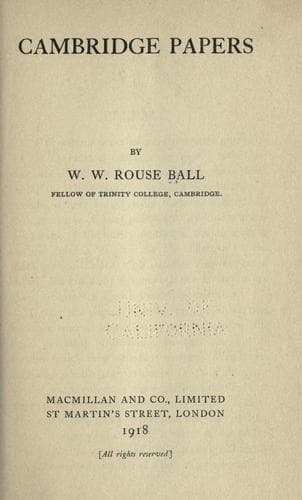
Cambridge PapersBall, W. W. Rouse (Walter William Rouse)
History
Cambridge Papers
Ball, W. W. Rouse (Walter William Rouse)
Trinity College (University of Cambridge); University of Cambridge -- History
In May 1849, the board issued a report in which, after giving a review
of the past and existing state of the mathematical studies in the
University, they recommended that the mathematical theories of
electricity, magnetism, and heat should not be admitted as subjects of
examination. In the following year they issued a second report, in
which they recommended the omission of elliptic integrals, Laplace's
coefficients, capillary attraction, and the figure of the earth
considered as heterogeneous, as well as a definite limitation of
the questions in the lunar and planetary theories. In making these
recommendations the board were only recognizing what had become the
practice in the examination.
I may, in passing, mention a curious attempt which was made in 1853
and 1854 to assist candidates to estimate the relative difficulty of
the questions asked. This was effected by giving to the candidates,
at the same time as the examination paper, a slip of paper on which
the marks assigned for the bookwork and rider for each question were
printed. I mention the fact merely because these things are rapidly
forgotten and not because it is of any intrinsic value. I possess a
complete set of slips which came to me from Todhunter.
In 1856 there was an amusing difference of opinion between the
vice-chancellor and the moderators. The vice-chancellor issued a
notice to say that for the convenience of the University he had
directed the tripos lists to be published at 8.0 a.m. as well as at
9.0 a.m., but when members of the senate arrived at 8.0 the moderators
said that the list should not be read until 9.0.
Considerable changes in the scheme of examination were introduced in
1873. On 5 December 1865, the board had recommended the addition of
Laplace's coefficients and the figure of the earth considered as
heterogeneous as subjects of the examination; the report does not seem
to have been brought before the senate, but attention was called to
the fact that certain departments of mathematics and mathematical
physics found no place in the tripos schedules, and were neglected by
most students. Accordingly, a syndicate was appointed on 6 June 1867,
to consider the matter, and a scheme drawn up by them was approved in
1868[76] and came into effect in 1873.
The new scheme of examination was framed on the same lines as that of
1848. The subjects in the first three days were left unchanged, but an
extra day was added, devoted to the elements of mathematical physics.
The essence of the modification was the greatly extended range of
subjects introduced into the schedule of subjects for the last five
days, and their arrangement in divisions; the total marks awarded to
the questions in each of the five divisions being approximately in a
proportion to the total marks assigned to the questions in the first
three days as 2, 1, 1, 1, 2/3 to 1 respectively. Under these
regulations the number of examiners was increased from four to five.
Public-domain text, read in full here on John Shaqi.
Reviews
Reviews
No reviews yet
Be the first to share your thoughts on this work.
Elsewhere in the archive
Join the Discussion
Join the discussion
Sign in to leave a comment or review.
Sign InorCreate an account