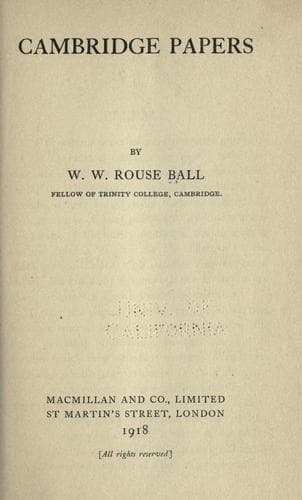
Cambridge PapersBall, W. W. Rouse (Walter William Rouse)
History
Cambridge Papers
Ball, W. W. Rouse (Walter William Rouse)
Trinity College (University of Cambridge); University of Cambridge -- History
The assignment of marks to groups of subjects was made under the
impression that the best candidates would concentrate their abilities
on a selection of subjects from the various divisions. But it was
found that, unless the questions were made extremely difficult, more
marks could be obtained by reading superficially all the subjects in
the five divisions than by attaining real proficiency in a few of the
higher ones: while the wide range of subjects rendered it practically
impossible to cover all the ground thoroughly in the time allowed.
The failure was so pronounced that in 1877 another syndicate was
appointed to consider the mathematical studies and examinations of the
University. They presented an elaborate scheme, but on 13 May 1878,
some of the most important parts of it were rejected; their subsequent
proposals, accepted on 21 November 1878 (by 62 to 49), represented a
compromise which pleased few members of the senate[77].
Under the new scheme which came into force in 1882 the tripos was
divided into two portions: the first portion was taken at the end of
the third year of residence, the range of subjects being practically
the same as in the regulations of 1848, and the result brought out in
the customary order of merit. The second portion was held in the
following January, and was open only to those who had been wranglers
in the preceding June. This portion was confined to higher mathematics
and appealed chiefly to specialists: the result was brought out in
three classes, each arranged in alphabetical order. The moderators and
examiners conducted the whole examination without any extraneous aid.
In the next year or two further amendments were made[78], the second
part of the examination being moved to the June of the fourth year,
and thrown open to all men who had graduated in the tripos of the
previous June. At the same time the conduct of the examination in
part II was transferred to four examiners nominated by the board: this
put it largely under the control of the professors. The range of
subjects of part II was also greatly extended, and candidates were
encouraged to select only a few of them. It was further arranged that
part I might be taken at the end of a man's second year of residence,
though in that case it would not qualify for a degree. A student who
availed himself of this leave could take part II at the end either of
his third or of his fourth year as he pleased.
Public-domain text, read in full here on John Shaqi.
Reviews
Reviews
No reviews yet
Be the first to share your thoughts on this work.
Elsewhere in the archive
Join the Discussion
Join the discussion
Sign in to leave a comment or review.
Sign InorCreate an account