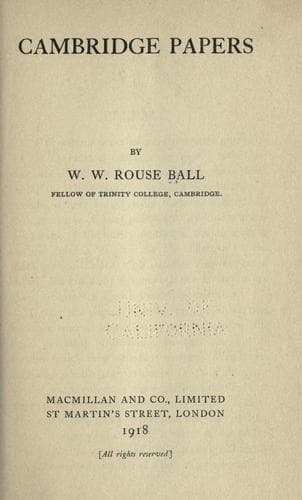
Cambridge PapersBall, W. W. Rouse (Walter William Rouse)
History
Cambridge Papers
Ball, W. W. Rouse (Walter William Rouse)
Trinity College (University of Cambridge); University of Cambridge -- History
With the rise of the senate-house examination the importance of this
class of teachers increased, for success in that examination was
regarded as the crown of the academic course, and brought with it, in
the shape of a fellowship, an immediate competence with a reasonable
prospect of an assured career. It was the business of private tutors
to prepare their pupils for the examination, and among those who in
this way came to the front shortly after the middle of the eighteenth
century were Richard Watson, John Wilson whose name is still known by
its association with a proposition in the theory of numbers, and
Robert Thorp. The last named teacher was described, about 1761, as
being "of eminent use to young men in preparing them for the
Senate-House Examinations and peculiarly successful"; and it was added
that "one young man of no shining reputation with the assistance of
Mr Thorp's tuition had stood at the head of wranglers."
In a grace of the senate, passed in 1781, it is stated that almost all
sophs then resorted to private tuition, and for more than a century
subsequently, the practice was well established. These were the men
who really directed the reading of the students. Even non-residents,
if reputed to be successful coaches, drew pupils. Thus John Dawson, a
medical practitioner at Sedbergh, regularly prepared pupils in the
vacations for the senate-house examination, and at least eleven of the
senior wranglers between 1781 and 1800 are known to have studied under
him.
During the nineteenth century the system developed under two
remarkable teachers, William Hopkins, 1793-1866, and Edward John
Routh, 1831-1907, to whom the vast majority of the better known
Cambridge mathematicians of this century owed most of what they learnt
in their undergraduate days. Hopkins in the twenty-two years from
1828-49, had among his pupils one hundred and seventy-five wranglers,
of whom seventeen were senior, forty-four in one of the first three
places, and one hundred and eight in one of the first ten places.
So too Routh, in the thirty-one years from 1858-88, had between six
hundred and seven hundred pupils, most of whom became wranglers,
twenty-seven being senior in the tripos and forty-one Smith's
prizemen. To organize teaching on this scale demanded rare gifts.
Public-domain text, read in full here on John Shaqi.
Reviews
Reviews
No reviews yet
Be the first to share your thoughts on this work.
Elsewhere in the archive
Join the Discussion
Join the discussion
Sign in to leave a comment or review.
Sign InorCreate an account