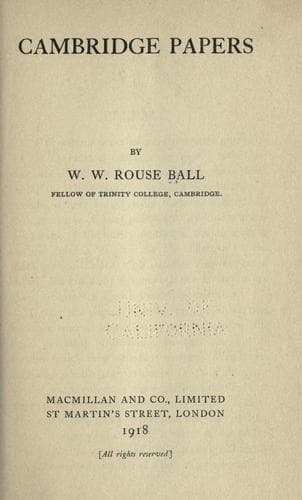
Cambridge PapersBall, W. W. Rouse (Walter William Rouse)
History
Cambridge Papers
Ball, W. W. Rouse (Walter William Rouse)
Trinity College (University of Cambridge); University of Cambridge -- History
The general effect of these changes was to destroy the homogeneity of
the tripos. Objections to the new scheme were soon raised. Especially,
it was said--whether rightly or wrongly--that part I contained too
many technical subjects to serve as a general educational training for
any save mathematicians; that the distinction of a high place in the
historic list produced on its results tended to prevent the best men
taking it in their second year, though by this time they had read
enough to be able to do so; and that part II was so constructed as to
appeal only to professional mathematicians, and thus the higher
branches of mathematics were neglected in the University by all save
a few specialists.
Whatever value be attached to these opinions, the number of students
studying mathematics fell rapidly under the scheme of 1886. In 1899
the board proposed[79] further changes. These seemed to some members
of the senate to be likely still further to decrease the number of men
who took up the subject as one of general education; and the two main
proposals were rejected, 15 February 1900 by votes of 151 to 130 and
161 to 129.
A few years later, in 1907[80], the board brought forward another
scheme, proposing changes so sweeping as almost to destroy the
identity of the tripos. Under this the examination in part II was
abolished--a change on which all parties were agreed. There was
introduced an examination, called part I, confined to elementary
mathematics, which could be taken as early as the second term of
residence, and for which in certain cases of failure a student could
present himself again, but this, although an examination for honours,
did not qualify for a degree. In the new part II, taken normally at
the end of the third year of residence and qualifying for a degree,
candidates were given some option in the subjects of their
examination, and order of merit was abolished. The first examination
under this scheme was held in 1908.
A remarkable feature in the history of the Cambridge mathematical
school is the fact that for nearly two hundred years most students
were accustomed to rely for preparation for it on work done with a
private tutor or "Coach." Towards the close of the seventeenth century
we first read of these "pupil-mongers" (among whom Laughton of Clare
was the most famous) who made it their business to prepare men for
their "acts."
Public-domain text, read in full here on John Shaqi.
Reviews
Reviews
No reviews yet
Be the first to share your thoughts on this work.
Elsewhere in the archive
Join the Discussion
Join the discussion
Sign in to leave a comment or review.
Sign InorCreate an account