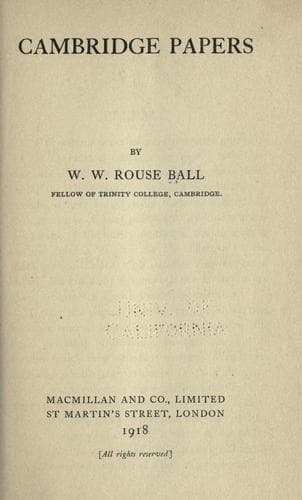
Cambridge PapersBall, W. W. Rouse (Walter William Rouse)
History
Cambridge Papers
Ball, W. W. Rouse (Walter William Rouse)
Trinity College (University of Cambridge); University of Cambridge -- History
The reconstitution in 1907 of the tripos, and the destruction of many
of its distinctive features must profoundly modify the future history
of mathematics at Cambridge, but forecasts on such a theme would be
useless.
The curious origin of the term tripos has been repeatedly told, and an
account of it may fitly close this chapter. Formerly there were three
principal occasions on which questionists were admitted to the title
or degree of bachelor. The first of these was at the comitia priora,
held on Ash-Wednesday, for the best men in the year. The next was at
the comitia posteriora, which was held a few weeks later, and at which
any student who had distinguished himself in the quadragesimal
exercises subsequent to Ash-Wednesday had his seniority reserved to
him. Lastly, there was the comitia minora, for students who had in no
special way distinguished themselves.
In the fifteenth century an important part in the ceremony on each of
these occasions was taken by a certain "ould bachilour," who sat upon
a three-legged stool or tripos before the proctors and tested the
abilities of the would-be graduates by arguing some question with the
"eldest son," who was selected from them as their representative. To
assist the latter in what might be an unequal contest his "father,"
that is, the officer of his college who was to present him for his
degree, was allowed to come to his assistance.
The discussion took place in Great St Mary's Church, and marked the
admission of the student to a position with new responsibilities,
while the season of Lent was chosen with a view to bring this into
prominence. The puritan party objected to the semi-ecclesiastical
character of the proceedings, and in the course of the sixteenth
century set themselves to bring the ceremony into disrepute. The part
played by the questionist now became purely formal, though a serious
debate still sometimes took place between the father of the senior
questionist and a regent master who represented the University: this,
however, came to be prefaced by a speech by the bachelor, who was now
called Mr Tripos, just as we speak of a judge as the bench, or of a
rower as an oar. Ultimately public opinion permitted Mr Tripos to say
pretty much what he pleased, so long as it was not dull and was
scandalous. The speeches he delivered or the verses he recited were
generally printed and preserved by the registrary, and were known as
the tripos verses: originally they referred to the subjects of the
disputations then propounded. The earliest copies now extant are those
for 1575.
Public-domain text, read in full here on John Shaqi.
Reviews
Reviews
No reviews yet
Be the first to share your thoughts on this work.
Elsewhere in the archive
Join the Discussion
Join the discussion
Sign in to leave a comment or review.
Sign InorCreate an account