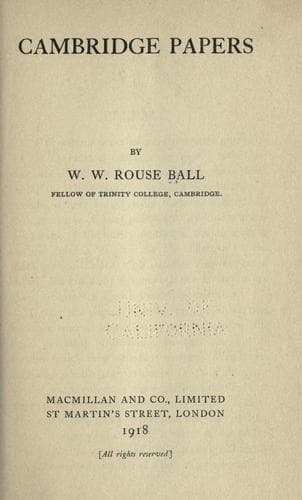
Cambridge PapersBall, W. W. Rouse (Walter William Rouse)
History
Cambridge Papers
Ball, W. W. Rouse (Walter William Rouse)
Trinity College (University of Cambridge); University of Cambridge -- History
The university officials, to whom the personal criticisms in which
Mr Tripos indulged were by no means pleasing, repeatedly exhorted him
to remember "while exercising his privilege of humour, to be modest
withal." In 1710, says Mullinger[81], "the authorities after
condemning the excessive license of the tripos announced that the
comitia at Lent would in future be conducted in the Senate-House; and
all members of the University, of whatever order or degree, were
forbidden to assail or mock the disputants with scurrilous jokes or
unseemly witticisms. About the year 1747-8, the moderators initiated
the practice of printing the honour lists on the back of the sheets
containing the tripos verses, and after the year 1755 this became the
invariable practice. By virtue of this purely arbitrary connection
these lists themselves became known as the tripos; and eventually the
examination itself, of which they represented the results, also became
known by the same designation."
Mr Tripos ceased to deliver his speech about 1750, but the issue of
tripos verses continued for nearly 150 years longer. During the latter
part of this time they consisted of four sets of verses, usually in
Latin, but occasionally in Greek, in which current topics in the
University were treated lightly or seriously as the writer thought
fit. They were written for the proctors and moderators by
undergraduates or commencing bachelors, each of whom was supposed to
receive a pair of white kid gloves in recognition of his labours. Thus
gradually the word tripos changed its meaning "from a thing of wood to
a man, from a man to a speech, from a speech to sets of verses, from
verses to a sheet of coarse foolscap paper, from a paper to a list of
names, and from a list of names to a system of examination[82]."
In 1895 the proctors and moderators, without consulting the senate,
sent in no verses, and thus, in spite of widespread regret, an
interesting custom of many centuries standing was destroyed. In
defence of this action, it was said that the custom had never been
embodied in statute or ordinance, and thus was not obligatory, and
further that its continuance was not of material benefit to anybody.
Such arguments are not conclusive, and we may well regret the
disappearance of historic ties unless it can be shown that they cause
inconvenience, which of course in this case could not be asserted.
By way of supplement to the foregoing account, I append a list of
those who have held or hold the various university mathematical chairs
and lectureships.
Public-domain text, read in full here on John Shaqi.
Reviews
Reviews
No reviews yet
Be the first to share your thoughts on this work.
Elsewhere in the archive
Join the Discussion
Join the discussion
Sign in to leave a comment or review.
Sign InorCreate an account