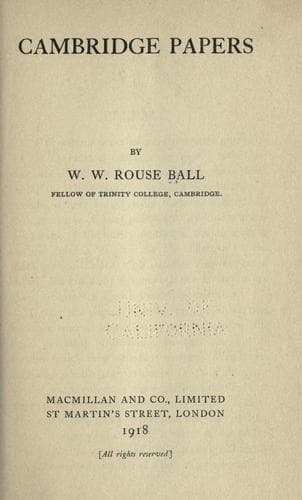
Cambridge PapersBall, W. W. Rouse (Walter William Rouse)
History
Cambridge Papers
Ball, W. W. Rouse (Walter William Rouse)
Trinity College (University of Cambridge); University of Cambridge -- History
In 1560 new statutes were granted to the College, and its constitution
as then settled remained practically unaltered till 1861. In this
code the foundation is described as including a master, sixty fellows,
four chaplains, sixty-two scholars, and thirteen sizars or gyps,
namely, three for the master and one for each of the ten senior
fellows. Henceforth scholars were elected annually in the spring, from
undergraduates already in residence. By a gracious provision, whose
disappearance in 1861 I regret, it was ordered that forty of the
scholarships should be specifically associated with the name of
Henry VIII, twenty with that of queen Mary, and two with that of
Thomas Allen as pre-eminent benefactors. Pensioners and subsizars were
also admissible to the Society on conditions. If fellow-commoners
dined at the high table, as seems likely, they may have been reckoned
extra numerum. Every student under the degree of master of arts was
required to have a tutor, thus regularizing the position of
fellow-commoners, pensioners, sizars, and subsizars as members of the
College, and bringing them under the same rule as scholars.
The regulations in point are as follows:
Est ea quidem ineuntis aetatis imbecillitas ut provectiorum consilio
et prudentia necessario moderanda sit, et propterea statuimus et
volumus ut nemo ex baccalaureis, discipulis, pensionariis,
sisatoribus, et subsisatoribus tutore careat: qui autem caruerit,
nisi intra quindecim dies unum sibi paraverit, e collegio ejiciatur.
Pupilli tutoribus pareant, honoremque paternum ac reverentiam
deferant, quorum studium, labor, et diligentia in illis ad pietatem
et scientiam informandis ponitur. Tutores sedulo quae docenda sunt
doceant, quaeque etiam agenda instruant admoneantque. Omnia
pupillorum expensa tutores collegio praestent, et intra decem dies
cujusque mensis finiti aes debitum pro se ac suis omnibus senescallo
solvant. Quod ni fecerint, tantisper commeatu priventur dum pecunia
a se collegio debita dissolvatur. Cautumque esto ne pupillus
quispiam vel stipendium suum a thesaurariis recipiat vel rationem
pro se cum eisdem aliquando ineat, sed utrumque per tutorem semper
sub poena commeatus menstrui a dicto tutore collegio solvendi fieri
volumus.... Pensionarios ut studiorum socios in collegium
recipiendos statuimus; sitque in illis recipiendis ratio morum ac
doctrinae diligenter habita; magistris artium aut superioris gradus
unum, baccalaureis autem nullum omnino concedimus. Nemo illorum
admittatur nisi a decano seniore et primario lectore examinatus.
In time, serious discrepancies between the statutes and the practice
of the College grew up. Some, but not all, of these were removed in
1844, when the statutes were revised. The sentence above quoted
"magistris artium aut superioris gradus unum, baccalaureis autem
nullum omnino concedimus" was then struck out.
Public-domain text, read in full here on John Shaqi.
Reviews
Reviews
No reviews yet
Be the first to share your thoughts on this work.
Join the Discussion
Join the discussion
Sign in to leave a comment or review.
Sign InorCreate an account