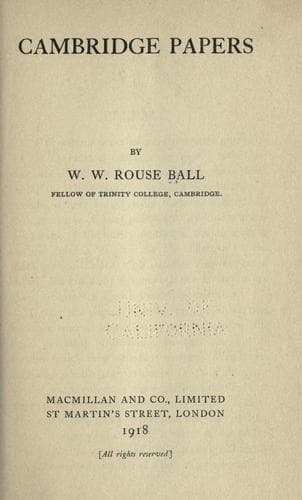
Cambridge PapersBall, W. W. Rouse (Walter William Rouse)
History
Cambridge Papers
Ball, W. W. Rouse (Walter William Rouse)
Trinity College (University of Cambridge); University of Cambridge -- History
Si tu is es, Clarissime Smithe, in quem Academia haec
Cantabrigiensis universas vires suas, universa pietatis jura
exercuerit, si tibi uni omnia doctrinae suae genera, omnia reipub.
ornamenta libentissime contulerit, si fructum gloriae suae in te uno
jactaverit, si spem salutis suae in te potissimum reposuerit: age
ergo, et mente ac cogitatione tua complectere, quid tu vicissim illi
debes, quid illa, quid literae, quid respublica, quid Deus ipse pro
tantis pietatis officiis, quibus sic dignitas tua efflorescit,
justissime requirit: Academia nil debet tibi, imo omnia sua in te
transfudit. Et propterea abs te non simpliciter petit beneficium,
sed merito repetit officium: nec unam aliquam causam tibi proponit,
sed sua omnia, et seipsam tibi committit. Nec sua necesse habet
aperire tibi consilia, quorum recessus et diverticula nosti
universa. Age igitur quod scis, et velis quod potes, et perfice
quod debes. Sic literis, academiae, reipublicae, et religioni; sic
Christo et Principi rem debitam et expectatam efficies. Jesus te
diutissime servet incolumem.
Parker tells us that the London friends of the University, among whom
Smith and Cheke were doubtless conspicuous, wisely took the line of
welcoming an enquiry, but begged the king to avoid the expense of a
costly investigation. Their representations were successful, and he
issued a commission[6] dated 16 January 1546 to Matthew Parker (then
vice-chancellor, and later archbishop of Canterbury), John Redman
(warden of King's Hall, chaplain to the king, and later master of
Trinity), and William Mey (president of Queens', and later
archbishop-elect of York) to report to him on the revenues of the
colleges and the numbers of students sustained therewith. The
commissioners were capable and friendly.
The king must have been impatient to know the facts, for in less than
a week, on 21 January, he ordered Parker to come to Hampton Court with
the report. Immediate compliance was impossible, but the command may
well have stimulated the commissioners to act as rapidly as possible.
In fact they obtained the services of eleven clerks from the Court of
Augmentations in London, and at once set to work to collect
information.
The University was keenly alive to the risks it was incurring. To
placate the king, the senate, on 13 February, put all its belongings
at his service, and when forwarding a copy of the grace to Secretary
Sir William Paget it reminded him of the value of the University to
the state, and begged his protection. At the same time it addressed
the queen, Katharine Parr, through Thomas Smith, imploring her
advocacy.[7]
Public-domain text, read in full here on John Shaqi.
Reviews
Reviews
No reviews yet
Be the first to share your thoughts on this work.
Join the Discussion
Join the discussion
Sign in to leave a comment or review.
Sign InorCreate an account