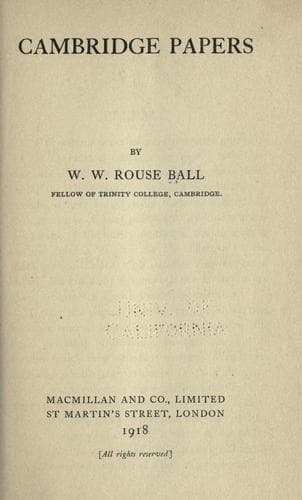
Cambridge PapersBall, W. W. Rouse (Walter William Rouse)
History
Cambridge Papers
Ball, W. W. Rouse (Walter William Rouse)
Trinity College (University of Cambridge); University of Cambridge -- History
4. "Howbeit in that kind of fruitfulness we also are not destitute
of God's gracious blessing; for ... besides Doctors in all faculties
to the number at the least of sixty, Deans to the number of eleven,
Publick Professors to the number of ten, the two Archbishops,
Canterbury and York, the most Reverend Fathers Whitgift and Hutton,
and seven other principal Prelates of this kingdom, namely, Fletcher
of London, Still of Bath and Wells, Babington of Worcester, Redman
of Norwich, Rud of St Davids, Bennet of Hereford, and Gouldesborough
of Gloucester, all of them simul et semel Bishops of this kingdom
... are such a demonstrative instance as we think no other College
in either University can afford the like--and not one of these
chosen out of Westminster School."
5. "It is to be doubted whether there can be the like success if our
Elections out of a private School shall be indubitate and certain;
we rather think there can be no readier means to make Droanes and
Loyterers in Colleges, nor any worse prejudice or more deadly bane
unto learning and vertue, then when the rewards, and means thereof
are tyed to persons, times, and places, and made regular and
certain."
6. The proposal would do a grave injustice to other students who
might be men of great abilities.
7. The proposal would defeat the express wishes of Henry VIII,
Edward VI, Mary, and Elizabeth, all of whom are to be reckoned as
founders as well as benefactors of Trinity College.
8 and 9. The proposal would be contrary to the existing statutes of
the College, and to the oaths taken by the Master and Fellows on
admission.
10. Preferences of this character are injurious to the particular
School, the College, and the whole University, and a constant source
of discord and contention.
11. "It is also against the Policy and common-wealth of a kingdom to
restrain and abridge places and preferments originally meant,
founded, and hitherto with good success employed for the common
benefit of that kingdom to a private School: for benefits and
privileges are to be amplified and not restrained; publick rewards
are not to be applied to private places, purposes, or respects."
12. Interference with the intentions and directions, of previous
benefactors is contrary to public policy, and tends to prevent
future benefactions.
13. This implies that Nevile had accepted the office of master of
Trinity College under promises which rendered it inequitable that
the college statutes should, during his tenure of the post, be
altered against his wishes, but it is stated that this argument,
though noted, is not to be pressed.
14. This raises some technical points, especially as to whether
statutes of a College given under the great seal can be varied by
letters patent without explicit reference to the clauses altered or
repealed.
Public-domain text, read in full here on John Shaqi.
Reviews
Reviews
No reviews yet
Be the first to share your thoughts on this work.
Join the Discussion
Join the discussion
Sign in to leave a comment or review.
Sign InorCreate an account