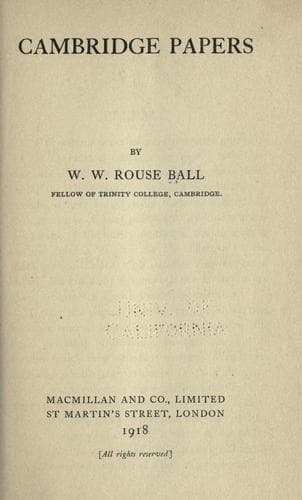
Cambridge PapersBall, W. W. Rouse (Walter William Rouse)
History
Cambridge Papers
Ball, W. W. Rouse (Walter William Rouse)
Trinity College (University of Cambridge); University of Cambridge -- History
The election in 1636 was interesting. It is said that among the
candidates was Cowley who had already written various poems and a
comedy showing distinct ability. The story runs that the boy failed
badly in grammar, and the Trinity electors, insisting that this was
conclusive, rejected him as a Westminster scholar, but offered him an
ordinary scholarship at Trinity, which he accepted. Against this are
the fact that he had been entered at Trinity as a pensioner in April,
a few weeks before the election at Westminster, and the improbability
that the electors would have drawn such a distinction between
Westminster and other scholars of the House. Still old-time anecdotes
are not to be lightly rejected: at any rate Cowley came into residence
in due course and was made a scholar in the same term as the four boys
taken from Westminster by the electors, these five students being the
only scholars elected by the College in 1637.
During the seventy-seven years from 1624 to 1700 inclusive, three
hundred and fifty-six scholars were elected from Westminster to
Trinity, of whom one hundred and twenty-six became fellows. During the
fifty years, 1701 to 1750, out of one hundred and eighty-seven
Westminster scholars at Trinity sixty-two became fellows; during the
fifty years, 1751 to 1800, out of one hundred and eighty, thirty
became fellows; and during the fifty-six years, 1801 to 1856, out of
one hundred and seventy, four became fellows. Throughout this long
period the friendly relations between the College and the school
suffered no change.
In 1727 there was a curious echo of the controversy of 1607. A strange
suggestion had been made, apparently with the tacit approval of the
authorities of Westminster, that new statutes should be given to
Trinity constituting the dean and chapter of Westminster Visitors of
the College, and it was decided by the advocates of the movement to
open the campaign by asking the dean of Westminster to call the
attention of the master of Trinity (Bentley), to the "Letters Anno
Quinto Jacobi Primi." Bentley replied on 5 March 1727, denied their
validity and argued that even if originally valid, they could not be
pressed after more than a century during which time "they had never
been acted upon": he added that, if antiquated letters were still
binding, there were various matters in which he had powers, whose
exercise might prove singularly inconvenient to those who had raised
the question. This was really conclusive, but further consideration
had shown the inherent weakness or folly of the original idea, and the
chapter was wise enough to proceed no further with the matter.
Public-domain text, read in full here on John Shaqi.
Reviews
Reviews
No reviews yet
Be the first to share your thoughts on this work.
Join the Discussion
Join the discussion
Sign in to leave a comment or review.
Sign InorCreate an account