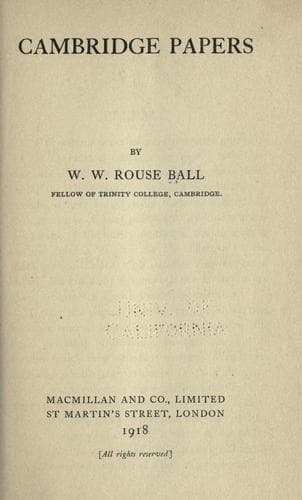
Cambridge PapersBall, W. W. Rouse (Walter William Rouse)
History
Cambridge Papers
Ball, W. W. Rouse (Walter William Rouse)
Trinity College (University of Cambridge); University of Cambridge -- History
The pictures in the large combination room of Isaac Newton by Thomas
Murray, and of Matthew Prior (1664-1721) by Godfrey Kneller are good:
the former came to us from a descendant (Mrs Ring) of Newton's
favourite niece, and its history is given in a letter from Charles
Simeon to Mansel, master of the College at the time of the gift. The
other canvasses are too big for a private apartment, but the portraits
of the "proud" duke of Somerset (1662-1748) by Nathaniel Dance, the
marquess of Granby (1721-70) by Joshua Reynolds, the duke of
Gloucester by John Opie, the marquess of Camden (1759-1840) by Thomas
Lawrence, the duke of Grafton (1760-1844) also by Lawrence, and the
duke of Sussex (1773-1843) by James Lonsdale, are of some repute: to
these there was added in 1915 a portrait of Arthur J. Balfour by
P.A. Laszlö de Lombros.
Of the peers mentioned above the names of Granby and Somerset are
still well known. Granby fought in the Culloden campaign, was colonel
of the blues (horse guards) at Minden, 1759; commander of the British
contingent in the campaigns of 1760, 1761, and 1762; and in 1766
became commander-in-chief of the army. Delighting in danger, which
even when in supreme command he deliberately sought, brave to a fault,
an excellent cavalry leader, rich and lavishly generous, he was the
idol of the public, and witnesses to his popularity remain in the
numerous public-houses scattered far and wide over England which bear
his name and arms. Somerset was of a very different type, being a
stupid man whose power was chiefly derived from his enormous landed
possessions. To the Somerset properties he added, by his marriage with
the sole heiress of the earls of Northumberland, the great estates of
the Percies. He held the chancellorship of the University for the
extraordinary term of sixty years. His title of the "proud duke"
commemorates only his arrogance, and was derived from the fact that
even to speak to anyone in a menial position was regarded by him as a
condescension. His servants were trained to understand his wishes by
signs, and numerous footmen surrounded him when in the streets so as
to avoid the risk that any people of the lower classes should approach
or address him. Perhaps the best known of the stories of his
pretensions refers to his remark to his second wife who once called
his attention to something by touching him with her fan (or according
to another version kissed him without asking his leave), "Madam," said
he, drawing himself apart, "my first wife never dared to take such a
liberty, and she was a Percy." As another illustration of his
character I may add that he deprived one of his daughters of £20,000
because she had sat down in his presence without asking his leave.
Public-domain text, read in full here on John Shaqi.
Reviews
Reviews
No reviews yet
Be the first to share your thoughts on this work.
Elsewhere in the archive
Join the Discussion
Join the discussion
Sign in to leave a comment or review.
Sign InorCreate an account