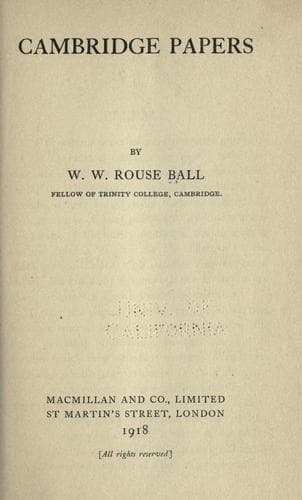
Cambridge PapersBall, W. W. Rouse (Walter William Rouse)
History
Cambridge Papers
Ball, W. W. Rouse (Walter William Rouse)
Trinity College (University of Cambridge); University of Cambridge -- History
The painted glass in the hall shows numerous coats of arms, and anyone
acquainted with heraldry will find here a rich field of study. The
windows could have been filled over and over again with the arms of
former famous members of the College, but the matter has been managed
in a haphazard way, and many distinguished sons of the House are
unrepresented. In spite of some bad glass the collection is
interesting. Perhaps however any further account of it here would be
more technical than would be justified in a paper like this. Of other
glass in the College, the windows in the chapel are typical of the art
of 1870, and are only moderately satisfactory. The window at the south
end of the library, executed in 1775, was made by Peckitt of York,
after a design by Cipriani: it illustrates some curious points in the
history of the art of stained glass, but the design is impossible, and
the scheme of colour atrocious.
Sculpture, unless it is absolutely first rate, does not represent a
man as well as portraiture. The number of pieces of statuary of the
first class in Great Britain is small, and in the possession of such
pieces the College is extraordinarily fortunate. The statue of Newton,
with its proud inscription "Newton qui genus humanum ingenio
superavit," in the antechapel by Roubiliac--"the marble index of a
mind for ever voyaging through strange seas of thought alone"--is of
the highest merit. It was described by Chantrey as "the noblest of
English statues," and I have never seen any modern piece of statuary
anywhere which can be ranked superior to it: the man lives and almost
moves. Thorwaldsen's statue of Byron, rejected by the authorities of
Westminster Abbey on account of his alleged atheistical opinions,
which stands in the library, and that of Bacon in the antechapel may
also be reckoned among examples of first-class statuary. Of these
three pieces two are by foreigners. There are also in the antechapel
statues of Barrow, Macaulay, Whewell, and Tennyson, and in the library
a large number of busts. The statues of Edward III on the clock tower,
of Henry VIII, James I, Anne of Denmark, and Prince Charles on the
great gate, and of queen Elizabeth on the queen's gate are
interesting, though not to be reckoned as works of art.
Old Silver Plate has a peculiar beauty. We have some fine specimens
though they are fewer and later than from our history we should
expect. Most of the pieces are kept in the butteries, and can be seen
by visitors. Twice a year anyone entering the hall will see the junior
bursar there with all the plate spread before him checking it by his
lists, a pretty spectacle which always suggests to me the picture of
the king "in his counting house counting out his money," and formerly
in "May-week" typical pieces were set out on show in the hall.
Public-domain text, read in full here on John Shaqi.
Reviews
Reviews
No reviews yet
Be the first to share your thoughts on this work.
Elsewhere in the archive
Join the Discussion
Join the discussion
Sign in to leave a comment or review.
Sign InorCreate an account