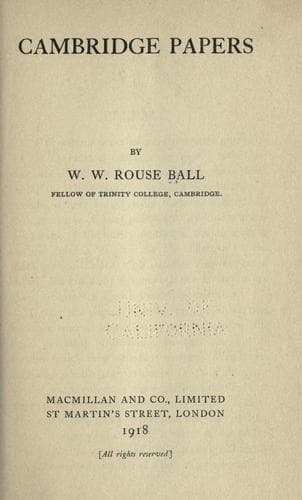
Cambridge PapersBall, W. W. Rouse (Walter William Rouse)
History
Cambridge Papers
Ball, W. W. Rouse (Walter William Rouse)
Trinity College (University of Cambridge); University of Cambridge -- History
Newton was succeeded in 1718 as auditor and registrar by Denys L'Isle.
L'Isle had been a fellow-commoner of Trinity Hall, admitted in 1712,
graduated LL.B. in 1715, who had gone down and in 1716 taken his name
off the books. He was a vigorous and not too scrupulous barrister. He
owed his appointment to Bentley, and he showed "extraordinary activity
and zeal in promoting all" his benefactor's "wishes and interests" and
represented him in some of his disputes. Whatever view may be taken of
Bentley's character, no one can justify his conduct in regard to the
college finances. A notable scandal occurred in the audit of 1722. In
the accounts of that year large sums were charged to the College for
works at the lodge and other sums spent by the master which had not
been sanctioned by the Society. Undoubtedly the charges were illegal,
but Bentley and L'Isle refused to allow the accounts to be examined by
the seniority. In fact in this, as in other matters, L'Isle had no
scruple in screening Bentley from the consequences of acts which were
neither legal nor honourable.
L'Isle died in 1727, and was succeeded as auditor, steward of the
courts, and registrar by William Greaves. Greaves had in 1719 migrated
to Clare, Cambridge, from Brasenose, Oxford; he graduated B.A. in
1720, and in 1722 was elected at Clare to a fellowship which he held
till 1742. He was a barrister and an able man: he too owed his office
to Bentley, and acted as his counsel in many of his tortuous
proceedings. Through Bentley's influence Greaves had in 1726 been made
commissary of the University, an office which he held till 1778. The
letters patent to the office of college auditor were made out for the
term of his life, but a question having been raised as to whether this
was statutable, he surrendered them, and the College granted new
patents for the term of fifty years if he should live so long. I
suppose he was duly admitted to the office, for probably an acute
lawyer would have seen to this, but there is no record of the fact in
our books.
Greaves seems to have performed his duties as auditor in an
honourable manner. After the audit of 1778, he surrendered his office
at the close of fifty years' tenure of it: he then received a present
of plate from the College, with their thanks for his long and faithful
services. Six years later he made a donation to the Society of £100 to
found an annual prize for an essay on the character of King William
the Third. After nearly a century it was said that the essayists had
exhausted the subject, and in 1882 the College got leave to substitute
for it one connected with the history of the British Empire.
Robert Graham, 1744-1836, a lawyer of note, succeeded Greaves. Graham
had graduated as third wrangler in 1766, and in the following year had
been elected to a fellowship. He held the office till after the audit
of 1791. He was made a baron of the exchequer in 1799, and proved a
singularly inefficient judge. He retired from the bench in 1827.
Public-domain text, read in full here on John Shaqi.
Reviews
Reviews
No reviews yet
Be the first to share your thoughts on this work.
Elsewhere in the archive
Join the Discussion
Join the discussion
Sign in to leave a comment or review.
Sign InorCreate an account