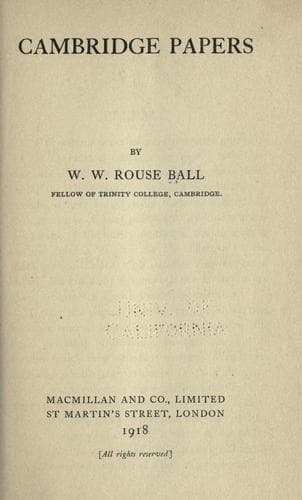
Cambridge PapersBall, W. W. Rouse (Walter William Rouse)
History
Cambridge Papers
Ball, W. W. Rouse (Walter William Rouse)
Trinity College (University of Cambridge); University of Cambridge -- History
Graham's chief distinction is said to have been his urbanity, and at
the Bar it was currently believed that no one but his sempstress had
power to ruffle his equanimity. He was somewhat pompous, and an
adventure of his at the assizes at Newcastle afforded much amusement
to his contemporaries. There, on one occasion just before charging the
grand jury, he tumbled, unnoticed, into the river from the garden of
the house where he lodged, but luckily was hauled out by some passing
watermen. The rough remedies of the quay-side failed to restore
consciousness, and the bystanders, supposing he was drowned, carted
him to a dead-house, where he was stripped and laid out. The coroner's
jury, summoned with unusual celerity, had viewed the body, and were
considering their verdict when, to their surprise he showed signs of
life and came to himself. His position was not altogether dignified,
but realizing at once that it is always incumbent on a judge to move
in state, he was by his directions fetched from the mortuary in the
sheriff's carriage, with the trumpeters, and usual ceremonial.
Of Graham's successor, Samuel Knight, 1755-1829, I know little. He had
been admitted as a pensioner in 1772, became a fellow-commoner in
1774, and graduated in the poll in 1776. Apparently he had no special
qualifications for the post beyond being a pleasant member of society.
He resigned in 1812, and died in 1829.
After Knight's resignation, the post was offered to Nicholas Conyngham
Tindal, 1776-1846, a lawyer of distinction. He had graduated in 1799
as eighth wrangler, was a Chancellor's medalist, and had been elected
to a fellowship in 1801, which, as he did not take orders, he had
vacated in due course in accordance with the provisions of the
Elizabethan statutes. The plan of offering the post to a
distinguished past fellow now became the custom, and all the auditors
hereafter mentioned were past fellows of the college.
Tindal was one of the counsel for queen Caroline; he is celebrated in
the history of the courts for having secured to a criminal client the
right of wager of battle, which had long fallen into disuse but had
not been abolished by statute. He was member for the University from
1827 to 1829 in which year he was made chief justice of the Common
Pleas; he held that office till his death in 1846. Though not
specially successful as an advocate, he had a profound knowledge of
law and was an excellent judge. His enormous dimensions are
commemorated in a print in my possession with the inscription "Judges
of A Size," representing him standing by Joshua Williams one of his
colleagues on assize, who was very diminutive; probably this is an
ancient joke.
Public-domain text, read in full here on John Shaqi.
Reviews
Reviews
No reviews yet
Be the first to share your thoughts on this work.
Elsewhere in the archive
Join the Discussion
Join the discussion
Sign in to leave a comment or review.
Sign InorCreate an account