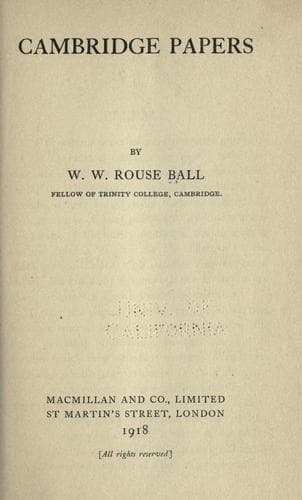
Cambridge PapersBall, W. W. Rouse (Walter William Rouse)
History
Cambridge Papers
Ball, W. W. Rouse (Walter William Rouse)
Trinity College (University of Cambridge); University of Cambridge -- History
The next auditor was James Parke, 1782-1868, a lawyer of even greater
distinction. He had graduated in 1803 as fifth wrangler, and had been
Craven scholar, Browne's medalist and Chancellor's medalist. In 1804
he had been elected to a fellowship. He was one of the counsel briefed
against queen Caroline. He was made a judge in 1828, and of course
then resigned the office of auditor, which he thus held for only three
years.
Parke had a profound knowledge of the common law, and admired, and was
a rigid adherent of, ancient forms and customs. The fact was well
known, and led to a curious scene, when on one occasion, while giving
a judgment, he fainted. Cold water and smelling salts were applied
without success, whereon a somewhat malicious colleague brought from
an adjacent room an ancient volume of reports, black with the dust of
ages, and banged it under the nostrils of the judge. It may have been
a coincidence, but Parke at once revived, and in a few minutes was
able to proceed with the business in hand.
At one time when Parke was trying a criminal case the prisoner
confessed his crime to his advocate, who thereupon (most improperly)
acquainted the judge with the fact and asked his advice. Parke rebuked
the barrister for informing him of the prisoner's guilt, but added
that counsel was not the less bound to defend his client to the best
of his ability. The case has been often cited, and states the practice
of the bar; it being of course assumed that nothing is said or done
for the defence which an honourable man might not say or do.
Parke's subsequent career served to settle a constitutional question
of great importance. In 1856 he was created Baron Wensleydale with a
life peerage. It was decided that the power of the crown to create
life peerages had been lost by disuse. He was then made a baron with
the usual remainder in tail male.
Parke was followed as auditor by Andrew Amos, 1791-1860, also a lawyer
of distinction. He had graduated as fifth wrangler in 1813, and in
1815 had been elected to a fellowship. He was appointed auditor in
1829. He had a large arbitration practice, acted on the Criminal Law
Commission, and was professor of English Law in London. In 1837 he was
appointed legal member of the Indian Council, and on his departure for
the East had to resign his office in the college. On the first vacancy
after his return to England, he was, in 1848, elected Downing
Professor of Laws in Cambridge, and occupied the chair until his
death.
Public-domain text, read in full here on John Shaqi.
Reviews
Reviews
No reviews yet
Be the first to share your thoughts on this work.
Elsewhere in the archive
Join the Discussion
Join the discussion
Sign in to leave a comment or review.
Sign InorCreate an account