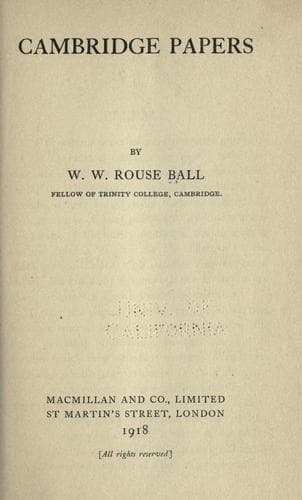
Cambridge PapersBall, W. W. Rouse (Walter William Rouse)
History
Cambridge Papers
Ball, W. W. Rouse (Walter William Rouse)
Trinity College (University of Cambridge); University of Cambridge -- History
18. Whewell died in 1866, and was succeeded as master by Thompson, and
he in 1886 by Butler. With their masterships we come to the affairs of
to-day. The 1882 statutes opened a new chapter in our history;
restrictions on the marriage of fellows were removed, and successful
teachers thus encouraged to remain in residence; incidentally, this
created a new social atmosphere. In this and other ways the conditions
of academic life were considerably changed. We need not, however, shun
a comparison with older times: if you want to see how freely Trinity
during the late Victorian period spent itself in the public service
look down any list of judges, bishops, statesmen, colonial governors,
and civil servants of the time, and in all you will find many Trinity
men conspicuous. Confining ourselves strictly to academic work in
Cambridge and to those who have now [1906] passed away, I may mention
the names of Clerk Maxwell in physics, of Cayley in mathematics, of
Munro and Jebb in classics, of Thompson in Greek philosophy, of
Sidgwick in ethics, and of Westcott, Lightfoot, and Hort in theology:
all of these were fellows of the College, and professors in the
University.
19. This is a bare summary of a complex story. Of the spirit that
actuates the College, of all that makes it a living Society, I have
said little. In truth, these are incapable of analysis. The charm that
the place perennially exercises on those who, generation after
generation, make it their home, the affection it inspires, are
intangible: they exist, there are but few members of the House who
have not felt them, and perhaps that is all I need say on this aspect
of our history.
[Footnote 29: A paper read to a party of north-country students
visiting the College in 1906.]
[Footnote 30: On some of the items in Whitgift's tutorial ledgers, see
above, chapter ii, pp. 36-39: the bills are printed at length in
volumes 32 and 33 of the _British Magazine_, 1847, 1848. Other
information on the daily life of students of the time is given in the
statutes of 1560. An interesting list of the outfit and furniture in
the rooms of a fellow-commoner in 1577 was printed by C.H. Cooper,
_Annals of Cambridge_, vol. II, pp. 352-356.]
PART II.
=Concerning the University.=
CHAPTER XI.
THE BEGINNINGS OF THE MEDIEVAL UNIVERSITY.
The problems connected with the beginnings of the University of
Cambridge and the conditions of life in its early days have always
interested me. Much is uncertain and open to various readings[31], but
the following is a summary of the story, as it appears to me.
Public-domain text, read in full here on John Shaqi.
Reviews
Reviews
No reviews yet
Be the first to share your thoughts on this work.
Elsewhere in the archive
Join the Discussion
Join the discussion
Sign in to leave a comment or review.
Sign InorCreate an account