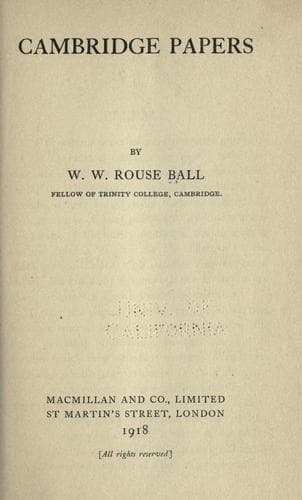
Cambridge PapersBall, W. W. Rouse (Walter William Rouse)
History
Cambridge Papers
Ball, W. W. Rouse (Walter William Rouse)
Trinity College (University of Cambridge); University of Cambridge -- History
First, as to the site of the University. About the end of the eleventh
century, Cambridge was little more than a village concentrated round
St Peter's church, having separate hamlets in its vicinity, one near
St Benet's church and the other at Newnham: at that time there was
nothing to suggest the likelihood of its being chosen by students as
a place where they might live and work in security. During the next
century, however, it became of considerable importance. This was due
to several causes. The chief of these were the castle erected in it
by William the Conqueror to overawe the fen-men; its geographical
location which gave it command of the river passage by which most of
the traffic between the midlands and the counties of Norfolk and
Suffolk went; its position as a port of entry for small sea-going
vessels coming from Lynn, of which a relic still survives in a bonded
warehouse on the banks of the Cam; its vicinity to Sturbridge common
on which came to be held one of the chief annual fairs in the kingdom;
and lastly the establishment here of the large monastic Houses of the
Augustin Canons, of the Brethren of St John's Hospital, and of the
Nuns of St Rhadegund: it would seem also that it became[32], maybe
under the authority of the secular canons of St Giles, the seat of a
grammar-school or schools. By 1200 the town had spread from castle-end
to where Christ's, Peterhouse, and Queens' now stand, and along the
east side of the river there were numerous small wharves, locally
known as hythes. The writs of Henry I and Henry II and the charter of
John bear witness to its importance in their reigns, but later this
tended to diminish relatively to other towns.
The Universities of Cambridge and Oxford were initiated near the end
of the twelfth century, both arising in towns free from disorder and
where accommodation for students was obtainable. It was a time when
men of scholarly tastes, especially those resident in religious
houses, were conscious of their ignorance of recent developments in
theology as set out by Peter Lombard and in canon law, and were keen
to study these subjects and scholastic logic. Schools to meet these
needs arose in Cambridge and Oxford and became permanent. Like centres
of instruction were established in other places, but for one reason or
another did not survive long as degree-granting corporations.
Public-domain text, read in full here on John Shaqi.
Reviews
Reviews
No reviews yet
Be the first to share your thoughts on this work.
Elsewhere in the archive
Join the Discussion
Join the discussion
Sign in to leave a comment or review.
Sign InorCreate an account