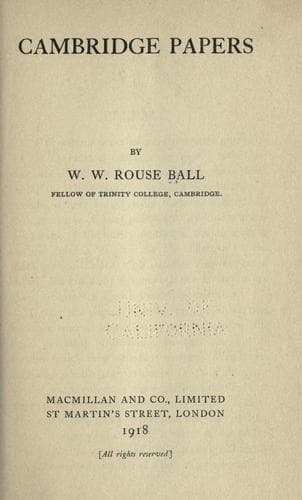
Cambridge PapersBall, W. W. Rouse (Walter William Rouse)
History
Cambridge Papers
Ball, W. W. Rouse (Walter William Rouse)
Trinity College (University of Cambridge); University of Cambridge -- History
Originally the main source of university authority was the body of
active teachers (regents) acting with the concurrence of the
chancellor who represented the bishop of Ely; their grouping in
faculties was an obvious development, and probably took place early in
the thirteenth century. Resident graduates who had ceased to teach
(non-regents) were allowed a voice on matters of property, rights, and
privileges. The establishment of monasteries and colleges with
administrative officers tended to retain in residence graduates who
were not lecturing; through them the house of non-regents grew in
power, and finally in many questions obtained concurrent jurisdiction
with that of the regents--the result was a very complex constitution.
At first the University had no buildings of its own; the regent and
non-regent houses met in St Benet's or St Mary's church, and lectures
were given wherever accommodation could be obtained. After this
digression I return to the position of the students in the early
University.
Numerous monasteries were established in Cambridge during the
thirteenth century, and from this I infer that the number of members
of the religious Orders studying in the University steadily increased
during that century. Of monastic Houses in Cambridge previous to the
foundation of the University I have already mentioned those of the
Augustin Canons, founded in connection with St Giles' church, about
1092, and moved in 1112 to Barnwell where their priory became in time
one of the largest conventual buildings in England, and of the Austin
Brethren of Frost's or St John's Hospital, built about 1135 on ground
now occupied by St John's College. Shortly after the organization of
a studium in the town, five important Orders established Houses here.
These were the Franciscan or Grey Friars, who, from their first home
situated near the present Divinity Schools and used from 1224 to 1294,
removed in 1294 to a site now occupied by Sidney Sussex College, where
their church was one of the conspicuous architectural features of
medieval Cambridge; the Dominican or Black Friars, who built in 1274
on ground now occupied by Emmanuel College; the Carmelite or White
Friars, who, having previously lived in houses at Chesterton and
Newnham, removed in 1290 to a site now occupied by Queens' and King's
Colleges; the Augustine Friars, who built, about 1290, a home on or
near ground now occupied by the university examination halls and
lecture rooms, in the basement of which some fragments of the old
friary may be found; and the Sempringham or White Canons, who about
1290 obtained possession of St Edmund's Priory which had been built
before 1278 near the Trumpington Gate. The Houses of the Bethlehem
Friars, opened in 1257, of the Friars of the Sack, opened in 1258, and
of the Friars of St Mary, opened in 1273, were suppressed in 1307, and
probably were never important foundations. I believe that the presence
Public-domain text, read in full here on John Shaqi.
Reviews
Reviews
No reviews yet
Be the first to share your thoughts on this work.
Elsewhere in the archive
Join the Discussion
Join the discussion
Sign in to leave a comment or review.
Sign InorCreate an account