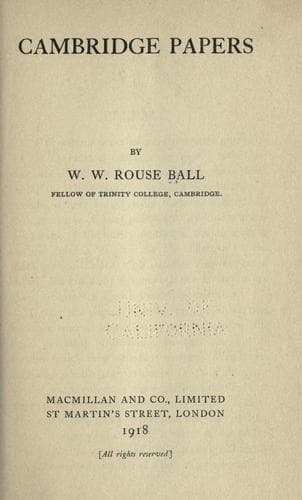
Cambridge PapersBall, W. W. Rouse (Walter William Rouse)
History
Cambridge Papers
Ball, W. W. Rouse (Walter William Rouse)
Trinity College (University of Cambridge); University of Cambridge -- History
It is not known whether the University of Cambridge began with a few
teachers taking up their residence in the town, giving instruction,
and attracting students and other teachers, or whether it started
ready-made by a migration of a body of discontented teachers and
students from some existing school. I believe the former view to be
correct. If so, we may reasonably assume that a considerable
proportion of the earliest adult students were previously living in
monastic houses here or in the neighbouring fenland monasteries at
Ely, Peterborough, or Croyland. It has been suggested that at first
the lectures were given in the local grammar-schools: this is
probable, and would fit in with the secular organization of the
University and the fact that boys learning Latin grammar (glomerels)
were reckoned among its students. Probably the movement was started
with the sanction and direct encouragement of the bishop of Ely,
certainly it was not directly monastic, and more likely the teachers
were secular clerks and not monks. I conjecture that at first the
lecturers were strangers to the locality, but this in no way implies
that a fragment of another university, students as well as teachers,
migrated here as an organized body.
Whatever the origin of the University, its members organized
themselves for mutual aid and protection as a _Studium_ on the model
of that at Paris, with which it seems later to have been frequently
in touch. If we may trust ancient traditions quoted by Bulaeus and
Peacock, the early University had also some connection with the
studium of Orleans: this is possible but speculative. Bologna
represented another type of organization which, however, was not
adopted anywhere in England. The University of Cambridge existed in
working order in 1209, and in my opinion its origin may be safely
assigned to some time in the previous twenty years.
Of its external history during the century following its organization
we know little: we read of its chancellor in 1225, of French students
coming to it in 1229, of special privileges conferred by the crown in
1231 and 1251, of its recognition by the pope in 1233, and finally of
a papal grant in 1318--exceptional in extent--of all rights which were
or could be enjoyed by any university in Christendom. Oxford went
through somewhat similar stages. The two universities were closely
connected, and by 1333 their position had become so firmly established
that they agreed not to recognize any other studium in the kingdom,
and in fact after that year no other university was established in
England until less than a century ago.
Public-domain text, read in full here on John Shaqi.
Reviews
Reviews
No reviews yet
Be the first to share your thoughts on this work.
Elsewhere in the archive
Join the Discussion
Join the discussion
Sign in to leave a comment or review.
Sign InorCreate an account