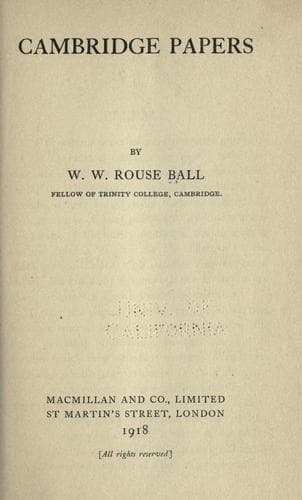
Cambridge PapersBall, W. W. Rouse (Walter William Rouse)
History
Cambridge Papers
Ball, W. W. Rouse (Walter William Rouse)
Trinity College (University of Cambridge); University of Cambridge -- History
A non-graduate student in arts was, before admission, expected to
know Latin, and, on admission, apprenticed to a master or doctor who
acted as a tutor in scholastic matters: in 1276 this system of
apprenticeship was made compulsory. The full medieval course lasted
several years. Students who entered as boys stayed, if they took the
full course, till they were grown men, gradually taking up teaching as
part of their course of study. The bachelors may have assisted in the
education of the younger arts students and of the glomerels who are
mentioned below, but normally instruction in the arts course was given
by masters, and in the higher faculties by doctors. The degree of
master was a license to teach, and newly created masters were required
to teach and to reside for two years (or later at least one year) for
that purpose. This pre-reformation scheme is in marked contrast to the
modern plan where the students enter as young men, all of about the
same age, with a normal course lasting three years or so, and with
their studies sharply differentiated from those of a limited number
of post-graduate and research students and of a separate body of
teachers. Mullinger estimated that during the medieval period the
number of resident regents varied from one hundred to two hundred, and
the number of students (apparently exclusive of monastic students)
never exceeded two thousand of whom the great majority were of humble
birth; no doubt there were wide variations in the numbers at different
times.
The history of Guilds in the University cannot be given with any
certainty. It may be that in the early years of the University most
secular students and teachers from any particular locality were
associated together as a guild, and perhaps every student on arrival
was expected to join his local guild, and through it become a member
of the University. The guilds imposed on their members definite rules
for their conduct in relation to one another, and enforced such
regulations by means of money fines, refusal of assistance, and in
extreme cases expulsion. The relations between the members of
different guilds were, however, often unfriendly or worse; in
particular there was constant friction between the guilds connected
with localities north and south of the Trent. It has been suggested
that at one time one of the proctors represented the cis-trentine
guilds and the other the trans-trentine guilds: this seems to have
been the case at Oxford, but there is no evidence of such a custom at
Cambridge where, according to Peacock, these trentine disputes were
less violent than at the sister University.
Public-domain text, read in full here on John Shaqi.
Reviews
Reviews
No reviews yet
Be the first to share your thoughts on this work.
Elsewhere in the archive
Join the Discussion
Join the discussion
Sign in to leave a comment or review.
Sign InorCreate an account