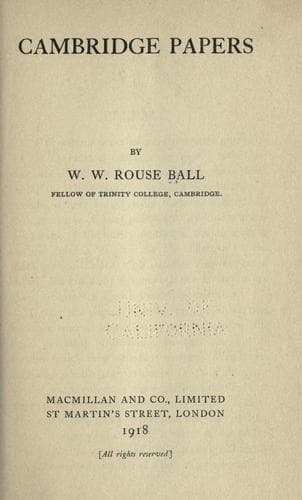
Cambridge PapersBall, W. W. Rouse (Walter William Rouse)
History
Cambridge Papers
Ball, W. W. Rouse (Walter William Rouse)
Trinity College (University of Cambridge); University of Cambridge -- History
We may take it that the master to whom a secular non-graduate student
was apprenticed looked after his studies, and probably officers of the
guild to which he belonged looked after him when sick or maltreated.
In other matters, however, he was left to take care of himself, and
thus was constantly liable to extortion. To meet this evil, the
University early obtained powers enabling it to settle, without
consulting the citizens, various local matters such as the prices of
lodging and food.
Besides students in arts there was also another class of secular
students consisting of boys, known as glomerels (grammarians) and
rhetoricians, who were under a special officer of the University
called the master of glomery. I conjecture that originally these were
the boys at the local grammar-schools, that after the foundation of
the University such boys were regularly treated as glomerel members of
it, and that for this reason we hear nothing more of the local
grammar-schools which had at first supplied them: most students of
this type must have lived at home and come from the town or immediate
neighbourhood. I suppose that in later times the number of glomerels
was swollen by the entry among them of students who had come to
Cambridge, and were found to be ignorant of Latin grammar, and so
inadmissible to the arts faculty.
The chief study of a glomerel was Latin grammar, and on attaining
reasonable proficiency in it he could change over to the arts faculty
if he wished. If a student continued in the glomerel faculty, the
degree of master in grammar (or rhetoric) was open to him, but in
processions of the University, such graduates took a lower place than
students in arts, and their inferior position was emphasized by a
statute which, while regulating the attendance of regents at the
funeral of a regent master or student in arts, stated that graduates
and scholars in grammar were not entitled to such recognition--_Illis
tantummodo exceptis, qui artem solam docent vel audiunt grammaticam,
ad quorum exequias nisi ex devotione non veniant supradicti_.
Public-domain text, read in full here on John Shaqi.
Reviews
Reviews
No reviews yet
Be the first to share your thoughts on this work.
Elsewhere in the archive
Join the Discussion
Join the discussion
Sign in to leave a comment or review.
Sign InorCreate an account