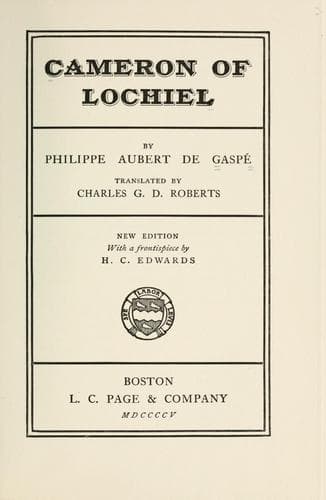
In Canada there is settling into shape a nation of two races; there
is springing into existence, at the same time, a literature in
two languages. In the matter of strength and stamina there is no
overwhelming disparity between the two races. The two languages are
admittedly those to which belong the supreme literary achievements of
the modern world. In this dual character of the Canadian people and the
Canadian literature there is afforded a series of problems which the
future will be taxed to solve. To make any intelligent forecast as to
the solution is hardly possible without a fair comprehension of the two
races as they appear at the point of contact. We, of English speech,
turn naturally to French-Canadian literature for knowledge of the
French-Canadian people. The romance before us, while intended for those
who read to be entertained, and by no means weighted down with didactic
purpose, succeeds in throwing, by its faithful depictions of life and
sentiment among the early French Canadians, a strong side-light upon
the motives and aspirations of the race.
In spite of the disclaimer with which the author begins, the romance
of Les Anciens Canadiens is a classic. From the literary point of
view it is markedly the best historical romance so far produced in
French Canada. It gathers up and preserves in lasting form the songs
and legends, the characteristic customs, the phases of thought and
feeling, the very local and personal aroma of a rapidly changing
civilization. Much of what de Gaspé has so vividly painted from his
boyish reminiscences had faded out of the life upon which his alert
eyes rested in old age. The origin of the romance, as given by his
biographer, the Abbé Casgrain, is as follows:
When, in 1861, that patriotic French-Canadian publication the _Soirées
Canadiennes_ was established, its inaugurators adopted as their motto
the words: "Let us make haste to write down the stories and traditions
of the people, before they are forgotten." M. de Gaspé was struck with
the idea; and seeing that the writers who were setting themselves the
laudable task were all young men, he took the words as a summons to his
old age, and so the book came to be written.
Patriotism, devotion to the French-Canadian nationality, a just pride
of race, and a loving memory for his people's romantic and heroic
past--these are the dominant chords which are struck throughout the
story. Of special significance, therefore, are the words which are put
in the mouth of the old seigneur as he bids his son a last farewell.
The father has been almost ruined by the conquest. The son has left
the French army and taken the oath of allegiance to the English crown.
"Serve thy new sovereign," says the dying soldier, "as faithfully as I
have served the King of France; and may God bless thee, my dear son!"
Public-domain text, read in full here on John Shaqi.
Reviews
Reviews
No reviews yet
Be the first to share your thoughts on this work.
Join the Discussion
Join the discussion
Sign in to leave a comment or review.
Sign InorCreate an account