Campaign and battle of Lynchburg, Va. — John Shaqi
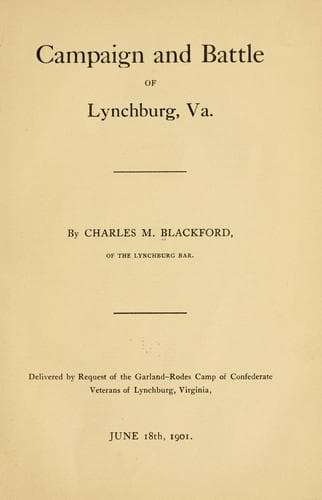
Campaign and battle of Lynchburg, Va.Blackford, Charles Minor
History
Campaign and battle of Lynchburg, Va.
Blackford, Charles Minor
Lynchburg (Va.) -- History -- Civil War, 1861-1865; Lynchburg, Battle of, Lynchburg, Va., 1864
On the 6th of June, 1864, General Grant wrote from the lines around
Richmond to General David Hunter, then commanding the Department of
West Virginia, informing him that General Sheridan would leave the
next day for Charlottesville for the purpose of destroying the Central
(now the Chesapeake & Ohio) Railway. Having given this information, he
directed General Hunter to operate with the same general end in view,
adding that "the complete destruction of this road and of the canal on
the James River is of great importance to us." He further says, "you
[Hunter] are to proceed to Lynchburg and commence there. _It would be
of great value to us to get possession of Lynchburg for a single day._"
According to this letter, Hunter, after reaching Staunton, was to move
on Lynchburg, _via_ Charlottesville, and thence along what Grant calls
"the Lynchburg branch of the Central Road," meaning the Lynchburg
extension of the Orange & Alexandria Railroad. Having captured
Lynchburg and destroyed the bridges and vast stores there concentrated,
he was to return by the same route, join Sheridan, and together they
were to move east and unite with Grant, who then proposed to move his
whole army south of the James and make his attack on Lee at, and south
of, Petersburg. (70 War of Rebellion, 598.)
Hunter was given some latitude as to how he should execute this order
and as to the best mode of reaching Lynchburg. It seems he determined
to move up the Valley, and to that end called on General William W.
Averell to "suggest a plan of operations, the purpose of which was the
capture of Lynchburg and the destruction of the railroads running from
that place in five days." (Id. 146.)
During the first three years of the war, raids were made upon the line
of the Virginia & Tennessee Railway (now Norfolk & Western) west of
Lynchburg, for the purpose of destroying Lee's communications with the
South and Southwest over that important conduit of supplies.
By these raids some damage was done by burning depots and overturning
bridges, but none which caused any permanent injury or produced any
serious delay in transportation over it. Except for local panics and
the destruction of a small amount of property, these raids were, from
a strategic point of view, a useless expenditure of military strength.
They did, however, fortunately direct the attention of the Confederate
authorities to the importance of this line and greatly increase their
vigilance.
Public-domain text, read in full here on John Shaqi.
Reviews
Reviews
No reviews yet
Be the first to share your thoughts on this work.
Join the Discussion
Join the discussion
Sign in to leave a comment or review.
Sign InorCreate an account