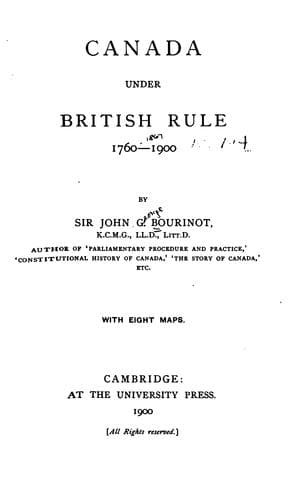
Canada under British Rule 1760-1900Bourinot, John George
History
Canada under British Rule 1760-1900
Bourinot, John George
Canada -- History
The political troubles that continued from 1817 until 1836 in Lower
Canada eventually made the working of legislative institutions
impracticable. The contest gradually became one between the
governor-general representing the crown and the assembly controlled
almost entirely by a French Canadian majority, with respect to the
disposition of the public revenues and expenditures. Imperial statutes,
passed as far back as 1774-1775, provided for the levying of duties, to
be applied solely by the crown, primarily "towards defraying the
expenses of the administration of justice and the support of the civil
government of the province", and any sums that remained in the hands of
the government were "for the future disposition of parliament." Then
there were "the casual or territorial revenues," such as money arising
from the Jesuits' estates, royal seigniorial dues, timber and land, all
of which were also exclusively under the control of the government. The
assembly had been given jurisdiction only over the amount of duties
payable into the treasury under the authority of laws passed by the
legislature itself. In case the royal revenues were not sufficient to
meet the annual expenditure of the government, the deficiency was met
until the war of 1812-15 by drawing on the military exchequer. As the
expenses of the provincial administration increased the royal revenues
became inadequate, while the provincial revenues gradually showed a
considerable surplus over the expenditure voted by the legislature. In
1813 the cost of the war made it impossible for the government to use
the military funds, and it resorted to the provincial moneys for the
expenses of justice and civil government. In this way, by 1817, the
government had incurred a debt of a hundred and twenty thousand pounds
to the province without the direct authority of the legislature. The
assembly of Lower Canada was not disposed to raise troublesome issues
during the war, or in any way to embarrass the action of Sir George
Prevost, who, whatever may have been his incompetency as a military
chief, succeeded by his conciliatory and persuasive methods in winning
the good opinions of the French Canadian majority and making himself an
exceptionally popular civil governor. After closing the accounts of the
war, the government felt it expedient to stop such irregular
proceedings, to obtain from the legislature a general appropriation act,
covering the amount of expenditures in the past, and to prevent the
necessity of such a questionable application of provincial funds in the
future. This may be considered the beginning of the financial
controversies that were so constant, as years passed by, between the
governors and the assemblies, and never ended until the rebellion broke
out. The assembly, desirous of obtaining power in the management of
public affairs, learned that it could best embarrass the government and
force them to consider and adjust public grievances, as set forth by the
Public-domain text, read in full here on John Shaqi.
Reviews
Reviews
No reviews yet
Be the first to share your thoughts on this work.
Elsewhere in the archive
Join the Discussion
Join the discussion
Sign in to leave a comment or review.
Sign InorCreate an account