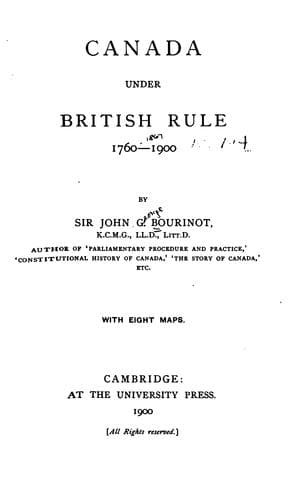
Canada under British Rule 1760-1900Bourinot, John George
History
Canada under British Rule 1760-1900
Bourinot, John George
Canada -- History
majority in the house, by means of the appropriation bills required for
the public service. The assembly not only determined to exercise sole
control over its own funds but eventually demanded the disposal of the
duties imposed and regulated by imperial statutes. The conflict was
remarkable for the hot and uncompromising temper constantly exhibited by
the majority on the discussion of the generally moderate and fair
propositions submitted by the government for settling vexed questions.
The assembly found a powerful argument in favour of their persistent
contention for a complete control of the public revenues and
expenditures in the defalcation of Mr. Caldwell, the receiver-general,
who had been allowed for years to use the public funds in his business
speculations, and whose property was entirely inadequate to cover the
deficiency in his accounts.
The legislative council was always ready to resist what it often
asserted to be unconstitutional acts on the part of the house and direct
infringements of "the rights of the crown" sometimes a mere convenient
phrase used in an emergency to justify resistance to the assembly. It
often happened, however, that the upper chamber had law on its side,
when the house became perfectly unreasonable and uncompromising in its
attitude of hostility to the government. The council, on several
occasions, rejected a supply bill because it contained provisions
asserting the assembly's right to control the crown revenues and to vote
the estimates, item by item, from the governor's salary down to that of
the humblest official. Every part of the official and legislative
machinery became clogged by the obstinacy of governor, councils, and
assembly. To such an extent, indeed, did the assembly's assumption of
power carry it in 1836, that the majority actually asserted its own
right to amend the constitution of the council as defined in the
imperial statute of 1791. Its indiscreet acts eventually alienated the
sympathy and support of such English members as Mr. Neilson, a
journalist and politician of repute, Mr. Andrew Stuart, a lawyer of
ability, and others who believed in the necessity of constitutional
reforms, but could not follow Mr. Papineau and his party in their
reckless career of attack on the government, which they thought would
probably in the end imperil British connection.
Public-domain text, read in full here on John Shaqi.
Reviews
Reviews
No reviews yet
Be the first to share your thoughts on this work.
Elsewhere in the archive
Join the Discussion
Join the discussion
Sign in to leave a comment or review.
Sign InorCreate an account