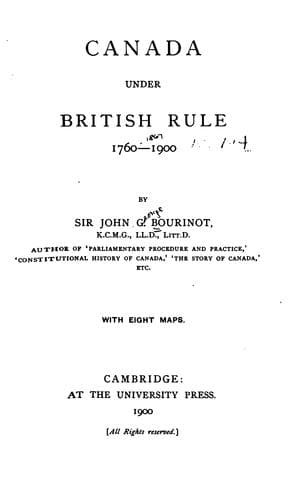
Canada under British Rule 1760-1900Bourinot, John George
History
Canada under British Rule 1760-1900
Bourinot, John George
Canada -- History
The imperial government immediately recognised that they had to face a
very serious crisis in the affairs of Lower Canada. On the 6th March,
1836, Lord John Russell, then home secretary in Lord Melbourne's
administration, introduced a series of ten resolutions, providing for
the immediate payment of the arrears of £142,160. 14s. 6d., due to the
public service, out of the moneys in the hands of the receiver-general.
While it was admitted that measures should be taken to secure for the
legislative council a greater degree of public confidence, the
government deemed it inexpedient to make that body elective. The
necessity of improving the position of the executive council was also
acknowledged, but the suggestion of a ministry responsible to the
assembly was not approved. This disapproval was quite in accordance with
the policy adopted by Englishmen since 1822, when a measure had been
introduced in parliament for the reunion of the two Canadas--the
precursor of the measure of 1840. This measure originally provided that
two members of the executive council should sit and speak in the
assembly but not vote. Those parts of the bill of 1822 which provided
for a union were not pressed on account of the objections raised in both
the provinces, but certain other provisions became law under the title
of "The Canadian Trade Acts," relieving Upper Canada from the
capricious action of Lower Canada with respect to the duties from which
the former obtained the principal part of her fund for carrying on her
government. This share had been originally fixed at one-fifth of the
proceeds of the customs duties collected by the province of Lower
Canada, but when the population of the western section increased
considerably and consumed a far greater quantity of dutiable goods, its
government justly demanded a larger proportion of the revenues collected
in the ports of the lower St. Lawrence. The legislature of Lower Canada
paid no attention to this equitable demand, and eventually even refused
to renew the legislation providing for the payment of one-fifth of the
duties. Under these circumstances the imperial government found it
necessary to intervene, and pass the "Trade Acts," making the past
legislation of Lower Canada on the subject permanent, and preventing its
legislature from imposing new duties on imports without the consent of
the upper province. As this was a question of grave import, the
resolutions of 1836 gave authority to the legislatures of Upper and
Lower Canada to provide joint legislation "for determining and adjusting
all questions respecting the trade and commerce of the provinces."
Public-domain text, read in full here on John Shaqi.
Reviews
Reviews
No reviews yet
Be the first to share your thoughts on this work.
Elsewhere in the archive
Join the Discussion
Join the discussion
Sign in to leave a comment or review.
Sign InorCreate an account