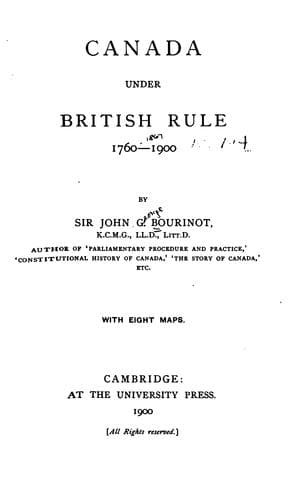
Canada under British Rule 1760-1900Bourinot, John George
History
Canada under British Rule 1760-1900
Bourinot, John George
Canada -- History
As soon as the passage of these resolutions became known throughout
Lower Canada, Papineau and his supporters commenced an active campaign
of denunciation against England, from whom, they declared, there was no
redress whatever to be expected. Wherever the revolutionists were in the
majority, they shouted, "_Vive la liberté!" "Vive la Nation Canadienne!"
"Vive Papineau!" "Point de despotisme_!": while flags and placards were
displayed with similar illustrations of popular frenzy. _La Nation
Canadienne_ was now launched on the turbulent waves of a little
rebellion in which the phrases of the French revolution were glibly
shouted by the _habitants_ with very little conception of their real
significance. The British or Constitutional party took active steps in
support of British connection, but Lord Gosford, unhappily still
governor-general, did not for some time awaken to the reality of the
public danger. Happily for British interests, Sir John Culhorne,
afterwards Lord Seaforth, a courageous and vigilant soldier, was in the
country, and was able, when orders were given him by the reluctant
governor, to deal determinedly with the rebels who had taken up arms in
the Richelieu district. Dr. Wolfred Nelson made a brave stand at St.
Denis, and repulsed Colonel Gore's small detachment of regulars.
Papineau was present for a while at the scene of conflict, but he took
no part in it and lost no time in making a hurried flight to the United
States--an ignominious close to a successful career of rhetorical
flashes which had kindled a conflagration that he took very good care
should not even scorch him. Colonel Wetherall defeated another band of
rebels at St. Charles, and their commander, Mr. Thomas Storrow Brown, a
well-meaning but gullible man, fled across the border. Dr. Wolfred
Nelson was captured, and a number of other rebels of less importance
were equally unfortunate. Some of the refugees made a public
demonstration from Vermont, but precipitately fled before a small force
which met them. At St. Eustache, one Girod, a plausible, mendacious
Swiss or Alsatian, who had become a leader in the rebellious movement,
and Dr. Chenier, a rash but courageous man, collected a considerable
body of rebels, chiefly from St. Benoit, despite the remonstrances of
Mr. Paquin, the curé of the village, and defended the stone church and
adjacent buildings against a large force, led by Sir John Colborne
himself. Dr. Chenier and many others--at least seventy, it is said on
good authority--were killed, and the former has in the course of time
been elevated to the dignity of a national hero and a monument raised in
his honour on a public square of the French Canadian quarters of
Montreal. Mad recklessness rather than true heroism signalised his
action in this unhappy affair, when he led so many of his credulous
compatriots to certain death, but at least he gave up his life manfully
to a lost cause rather than fly like Papineau who had beguiled him to
Public-domain text, read in full here on John Shaqi.
Reviews
Reviews
No reviews yet
Be the first to share your thoughts on this work.
Elsewhere in the archive
Join the Discussion
Join the discussion
Sign in to leave a comment or review.
Sign InorCreate an account