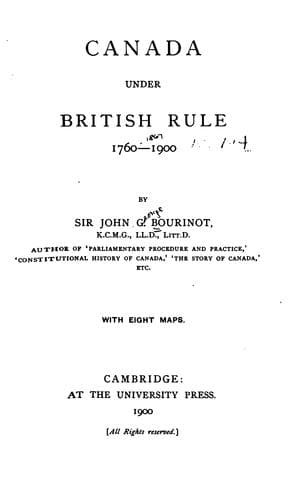
Canada under British Rule 1760-1900Bourinot, John George
History
Canada under British Rule 1760-1900
Bourinot, John George
Canada -- History
this melancholy conclusion. Even Girod showed courage and ended his own
life when he found that he could not evade the law. The rebellious
element at St. Benoit was cowed by the results at St. Eustache; and the
Abbé Chartier, who had taken an active part in urging the people to
resistance, fled to the United States whence he never returned. The
greater part of the village was destroyed by fire, probably in
retaliation for the losses and injuries suffered by the volunteers at
the hands of the rebels in different parts of the district of Montreal.
One of the most unfortunate and discreditable incidents of the rising in
the Richelieu district was the murder of Lieutenant Weir, who had been
taken prisoner while carrying despatches to Sorel, and was literally
hacked to pieces, when he tried to escape from a _calèche_ in which he
was being conveyed to St. Charles. An equally unhappy incident was the
cold-blooded execution, after a mock trial, of one Chartrand, a harmless
non-combatant who was accused, without a tittle of evidence, of being a
spy. The temper of the country can be gauged by the fact that when it
was attempted, some time later, to convict the murderers on clear
evidence, it was impossible to obtain a verdict. Jolbert, the alleged
murderer of Weir, was never punished, but François Nicholas and Amable
Daumais, who had aided in the trial and execution of Chartrand, were
subsequently hanged for having taken an active part in the second
insurrection of 1838.
The rebellion of 1837 never reached any large proportions, and very few
French Canadians of social or political standing openly participated in
the movement. Monseigneur Lartigue, Roman Catholic bishop of Montreal,
issued a _mandement_ severely censuring the misguided men who had joined
in the rebellious movement and caused so much misery throughout the
province. In England, strange to say, there were men found, even in
parliament, ready to misrepresent the facts and glory in a rebellion the
causes of which they did not understand. The animating motive with
these persons was then--and there were similar examples during the
American revolution--to assail the government of the day and make
political capital against them, but, it must be admitted, in all
fairness to the reform ministry of that day and even to preceding
cabinets for some years, that the policy of all was to be just and
conciliatory in their relations with the provincial agitators, though it
is also evident that a more thorough knowledge of political conditions
and a more resolute effort to a reach the bottom of grievances might
have long before removed causes of irritation and saved the loss of
property and life in 1837 and 1838.
Public-domain text, read in full here on John Shaqi.
Reviews
Reviews
No reviews yet
Be the first to share your thoughts on this work.
Elsewhere in the archive
Join the Discussion
Join the discussion
Sign in to leave a comment or review.
Sign InorCreate an account