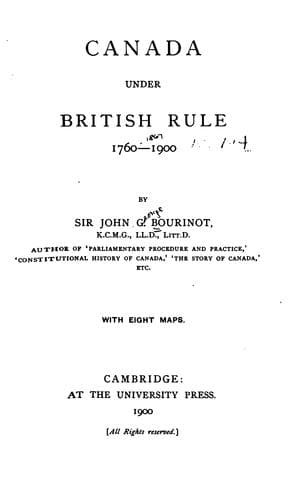
Canada under British Rule 1760-1900Bourinot, John George
History
Canada under British Rule 1760-1900
Bourinot, John George
Canada -- History
It was largely the dominant influence of the official combination, long
known in Canadian history as the "family compact," which prevented the
concession of responsible government before the union of the Canadas.
This phrase, as Lord Durham said in his report, was misleading inasmuch
as there "was very little of family connection between the persons thus
united." As a matter of fact the phrase represented a political and
aristocratic combination, which grew up as a consequence of the social
conditions of the province and eventually monopolised all offices and
influence in government. This bureaucracy permeated all branches of
government--the executive, the legislative council, and even the
assembly where for years there sat several members holding offices of
emolument under the crown. It practically controlled the banks and
monetary circles. The Church of England was bound up in its interests.
The judiciary was more or less under its influence while judges were
appointed during pleasure and held seats in the councils. This governing
class was largely composed of the descendants of the Loyalists of 1784,
who had taken so important a part in the war with the United States and
always asserted their claims to special consideration in the
distribution of government favour. The old settlers--all those who had
come into the country before the war--demanded and obtained greater
consideration at the hands of the government than the later immigrants,
who eventually found themselves shut out of office and influence. The
result was the growth of a Liberal or Reform party, which, while
generally composed of the later immigrants, comprised several persons of
Loyalist extraction, who did not happen to belong to the favoured class
or church, but recognised the necessity for a change in the methods of
administration. Among these Loyalists must be specially mentioned Peter
Perry, who was really the founder of the Reform party in 1834, and the
Reverend Egerton Ryerson, a Methodist minister of great natural ability.
Public-domain text, read in full here on John Shaqi.
Reviews
Reviews
No reviews yet
Be the first to share your thoughts on this work.
Elsewhere in the archive
Join the Discussion
Join the discussion
Sign in to leave a comment or review.
Sign InorCreate an account