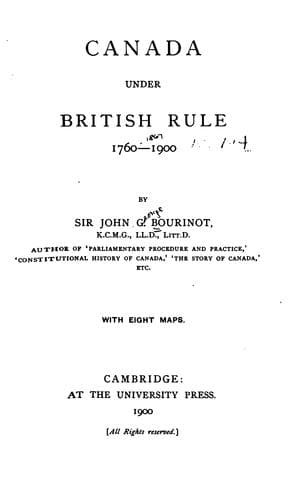
Canada under British Rule 1760-1900Bourinot, John George
History
Canada under British Rule 1760-1900
Bourinot, John George
Canada -- History
Unfortunately creed also became a powerful factor in the political
controversies of Upper Canada. By the constitutional act of 1791 large
tracts of land were set aside for the support of a "Protestant clergy",
and the Church of England successfully claimed for years an exclusive
right to these "clergy reserves" on the ground that it was the
Protestant church recognised by the state. The clergy of the Church of
Scotland in Canada, though very few in number for years, at a later time
obtained a share of these grants as a national religious body; but all
the dissentient denominations did not participate in the advantages of
these reserves. The Methodists claimed in the course of years to be
numerically equal to, if not more numerous than, the English
Episcopalians, and were deeply irritated at the inferior position they
long occupied in the province. So late as 1824 the legislative council,
composed of members of the dominant church, rejected a bill allowing
Methodist ministers to solemnise marriages, and it was not until 1831
that recognised ministers of all denominations were placed on an
equality in this respect. Christian charity was not more a
characteristic of those times than political liberality. Methodism was
considered by the governing class as a sign of democracy and social
inferiority. History repeated itself in Upper Canada. As the Puritans of
New England feared the establishment of an Anglican episcopacy, and used
it to stimulate a feeling against the parent state during the beginnings
of the revolution, so in Upper Canada the dissenting religious bodies
made political capital out of the favouritism shown to the Church of
England in the distribution of the public lands and public patronage.
The Roman Catholics and members of all Protestant sects eventually
demanded the secularisation of the reserves for educational or other
public purposes, or the application of the funds to the use of all
religious creeds. The feeling against that church culminated in 1836,
when Sir John Colborne, then lieutenant-governor, established forty-four
rectories in accordance with a suggestion made by Lord Goderich some
years previously. While the legality of Sir John Colborne's course was
undoubted, it was calculated to create much indignant feeling among the
dissenting bodies, who saw in the establishment of these rectories an
evidence of the intention of the British government to create a state
church so far as practicable by law within the province. This act, so
impolitic at a critical time of political discussion, was an
illustration of the potent influence exercised in the councils of the
government by Archdeacon Strachan, who had come into the province from
Scotland in 1799 as a schoolmaster. He had been brought up in the tenets
of the Presbyterian Church, but some time after his arrival in Canada he
became an ordained minister of the Church of England, in which he rose
step by step to the episcopacy. He became a member of both the executive
Public-domain text, read in full here on John Shaqi.
Reviews
Reviews
No reviews yet
Be the first to share your thoughts on this work.
Elsewhere in the archive
Join the Discussion
Join the discussion
Sign in to leave a comment or review.
Sign InorCreate an account