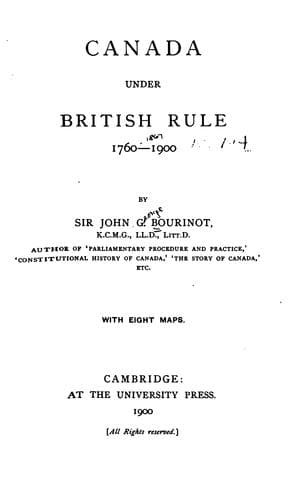
Canada under British Rule 1760-1900Bourinot, John George
History
Canada under British Rule 1760-1900
Bourinot, John George
Canada -- History
In 1834 he was elected first mayor of Toronto, then incorporated under
its present name, as a consequence of the public sympathy aroused in his
favour by his several expulsions. Previous to the election of 1835, in
which he was returned to the assembly, he made one of the most serious
blunders of his life, in the publication of a letter from Mr. Joseph
Hume, the famous Radical, whose acquaintance he had made while in
England. Mr. Hume emphatically stated his opinion that "a crisis was
fast approaching in the affairs of Canada which would terminate in
independence and freedom from the baneful domination of the mother
country, and the tyrannical conduct of a small and despicable faction in
the colony." The official class availed themselves of this egregious
blunder to excite the indignation of the Loyalist population against Mr.
Mackenzie and other Reformers, many of whom, like the Baldwins and
Perrys, disavowed all sympathy with such language. Mr. Mackenzie's
motive was really to insult Mr. Ryerson, with whom he had quarrelled.
Mr. Ryerson in the _Christian Guardian_, organ of the Methodists, had
attacked Mr. Hume as a person unfit to present petitions from the
Liberals of Canada, since he had opposed the measure for the
emancipation of slaves in the West Indies, and had consequently
alienated the confidence and sympathy of the best part of the nation.
Mr. Hume then wrote the letter in question, in which he also stated that
he "never knew a more worthless hypocrite or so base a man as Mr.
Ryerson proved himself to be." Mr. Mackenzie in this way incurred the
wrath of a wily clergyman and religious journalist who exercised much
influence over the Methodists, and at the same time fell under the ban
of all people who were deeply attached to the British connection.
Moderate Reformers now looked doubtfully on Mackenzie, whose principal
supporters were Dr. Duncombe, Samuel Lount, Peter Matthews, and other
men who took an active part in the insurrection of 1837.
In the session of 1835 a committee of grievances, appointed on the
motion of Mr. Mackenzie himself, reported in favour of a system of
responsible government, an elective legislative council, the appointment
of civil governors, a diminution of the patronage exercised by the
crown, the independence of the legislature, and other reforms declared
to be in the interest of good government. The report was temperately
expressed, and created some effect for a time in England, but the
colonial minister could not yet be induced to move in the direction of
positive reform in the restrictive system of colonial government.
Public-domain text, read in full here on John Shaqi.
Reviews
Reviews
No reviews yet
Be the first to share your thoughts on this work.
Elsewhere in the archive
Join the Discussion
Join the discussion
Sign in to leave a comment or review.
Sign InorCreate an account