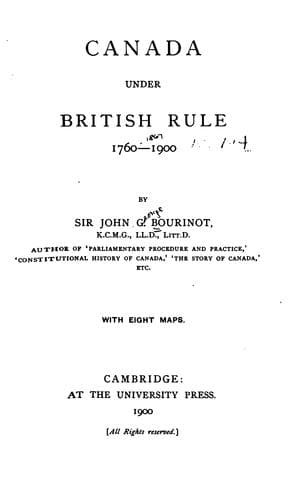
Canada under British Rule 1760-1900Bourinot, John George
History
Canada under British Rule 1760-1900
Bourinot, John George
Canada -- History
Unhappily, at this juncture, when good judgment and discretion were so
necessary in political affairs, all the circumstances combined to hasten
a perilous crisis, and to give full scope to the passionate impulses of
Mackenzie's nature. Sir John Colborne was replaced in the government of
the province by one of the most incapable governors ever chosen by the
colonial office, Sir Francis Bond Head. He had been chiefly known in
England as a sprightly writer of travels, and had had no political
experience except such as could be gathered in the discharge of the
duties of a poor-law commissioner in Wales. His first official act was
an indiscretion. He communicated to the legislature the full text of the
instructions which he had received from the king, although he had been
advised to give only their substance, as least calculated to hamper Lord
Gosford, who was then attempting to conciliate the French Canadian
majority in Lower Canada. These instructions, in express terms,
disapproved of a responsible executive and particularly of an elected
legislative council, to obtain which was the great object of Papineau
and his friends. Mr. Bidwell, then speaker of the assembly, recognised
the importance of this despatch, and forwarded it immediately to Mr.
Papineau, at that time speaker of the Lower Canadian house, with whom he
and other Reformers had correspondence from time to time. Lord Gosford
was consequently forced to lay his own instructions in full before the
legislature and to show the majority that the British government was
opposed to such vital changes in the provincial constitution as they
persistently demanded. The action of the Lower Canadian house on this
matter was communicated to the assembly of Upper Canada by a letter of
Mr. Papineau to Mr. Bidwell, who laid it before his house just before
the prorogation in 1835. In this communication the policy of the
imperial government was described as "the naked deformity of the
colonial system," and the royal commissioners were styled "deceitful
agents," while the methods of government in the neighbouring states were
again eulogised as in the ninety-two resolutions of 1834. Sir Francis
Bond Head seized the opportunity to create a feeling against the
Reformers, to whom he was now hostile. Shortly after he sent his
indiscreet message to the legislature he persuaded Dr. Rolph, Mr.
Bidwell and Receiver-General Dunn to enter the executive council on the
pretence that he wished to bring that body more into harmony with public
opinion. The new councillors soon found that they were not to be
consulted in public affairs, and when the whole council actually
resigned Sir Francis told them plainly that he alone was responsible for
his acts, and that he would only consult them when he deemed it
expedient in the public interest. This action of the lieutenant-governor
showed the Reformers that he was determined to initiate no changes which
would disturb the official party, or give self-government to the people.
Public-domain text, read in full here on John Shaqi.
Reviews
Reviews
No reviews yet
Be the first to share your thoughts on this work.
Elsewhere in the archive
Join the Discussion
Join the discussion
Sign in to leave a comment or review.
Sign InorCreate an account