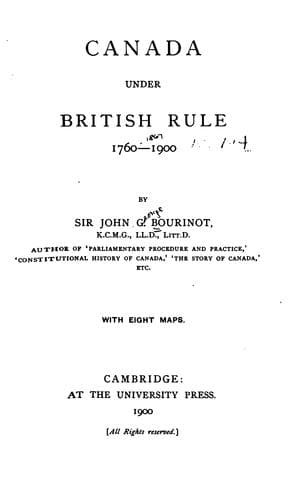
Canada under British Rule 1760-1900Bourinot, John George
History
Canada under British Rule 1760-1900
Bourinot, John George
Canada -- History
In the maritime provinces of Nova Scotia, New Brunswick, and Prince
Edward Island, there were no racial antagonisms to affect internal
development; and the political conflict never reached such proportions
as to threaten the peace and security of the people. In New Brunswick
the chief industry was the timber trade--deals especially--which
received its first stimulus in 1809, when a heavy duty was placed on
Baltic timber, while that from the colonies came free into the British
Isles. Shipbuilding was also profitably followed in New Brunswick, and
was beginning to be prosecuted in Nova Scotia, where, a few years later,
it made that province one of the greatest ship-owning and ship-sailing
communities of the world until iron steamers gradually drove wooden
vessels from the carrying trade. The cod, mackerel, and herring
fisheries--chiefly the first--were the staple industry of Nova Scotia,
and kept up a large trade with the British West Indies, whence sugar,
molasses and rum were imported. Prince Edward Island was chiefly an
agricultural community, whose development was greatly retarded by the
wholesale grant of lands in 1767 to absentee proprietors. Halifax and
St. John had each a population of twenty thousand. The houses were
mostly of wood, the only buildings of importance being the government
house, finished in 1805, and the provincial or parliament house,
considered in its day one of the handsomest structures in North America.
In the beautiful valleys of Kings and Annapolis--now famous for their
fruit--there was a prosperous farming population. Yarmouth illustrated
the thrift and enterprise of the Puritan element that came into the
province from New England at an early date in its development. The
eastern counties, with the exception of Pictou, showed no sign of
progress. The Scotch population of Cape Breton, drawn from a poor class
of people in the north of Scotland, for years added nothing to the
wealth of an island whose resources were long dormant from the absence
of capital and enterprise.
Popular education in those days was at the lowest possible ebb. In 1837
there were in all the private and public schools of the provinces only
one-fifteenth of the total population. In Lower Canada not one-tenth
could write. The children of the _habitants_ repeated the Catechism by
rote, and yet could not read as a rule. In Upper Canada things were no
better. Dr. Thomas Rolph tells us that, so late as 1833, Americans or
other anti-British adventurers carried on the greater proportion of the
common schools, where the youth were taught sentiments "hostile to the
parent state" from books used in the United States--a practice stopped
by statute in 1846.
Public-domain text, read in full here on John Shaqi.
Reviews
Reviews
No reviews yet
Be the first to share your thoughts on this work.
Elsewhere in the archive
Join the Discussion
Join the discussion
Sign in to leave a comment or review.
Sign InorCreate an account