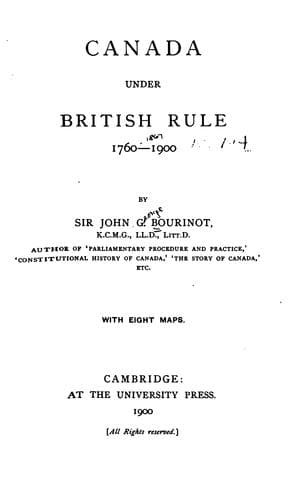
Canada under British Rule 1760-1900Bourinot, John George
History
Canada under British Rule 1760-1900
Bourinot, John George
Canada -- History
Lord Metcalfe, at the very outset, decided not to distribute the
patronage of the crown under the advice of his responsible advisers, but
to ignore them, as he declared, whenever he deemed it expedient. No
responsible ministers could, with any regard to their own self-respect,
or to the public interests, submit to a practice directly antagonistic
to responsible government, then on its trial. Consequently, all the
members of the Baldwin-Lafontaine government, with the exception of Mr.
Daly, immediately resigned, when Lord Metcalfe followed so
unconstitutional a course. Mr. Dominick Daly, afterwards knighted when
governor of Prince Edward's Island--who had no party proclivities, and
was always ready to support the crown in a crisis--became nominally
head of a weak administration. The ministry was only completed after a
most unconstitutional delay of several months, and was even then only
composed of men whose chief merit was their friendliness to the
governor, who dissolved the assembly and threw all the weight of the
crown into the contest. The governor's party was returned with a very
small majority, but it was a victory, like that of Sir Francis Bond Head
in 1835, won at the sacrifice of the dignity of the crown, and at the
risk of exciting once more public discontent to a dangerous degree. Lord
Metcalfe's administration was strengthened when Mr. Draper resigned his
legislative councillorship and took a seat in the assembly as leader.
Lord Metcalfe's conduct received the approval of the imperial
authorities, who elevated him to the peerage--so much evidence that they
were not yet ready to concede responsible government in a complete
sense. The result was a return to the days of old paternal government,
when the parliamentary opposition was directed against the governor
himself and the British government of which he was the organ. Lord
Metcalfe had been a sufferer from cancer, and when it appeared again in
its most aggravated form he returned to England, where he died a few
months later (1846). The abuse that followed him almost to the grave was
a discreditable exhibition of party rancour, but it indicated the
condition to which the public mind had been brought by his unwise and
unconstitutional conduct of public affairs--conduct for which his only
apology must be the half-hearted, doubtful policy of the imperial
authorities with regard to the province, and his own inability to
understand the fundamental principles of responsible government.
Public-domain text, read in full here on John Shaqi.
Reviews
Reviews
No reviews yet
Be the first to share your thoughts on this work.
Elsewhere in the archive
Join the Discussion
Join the discussion
Sign in to leave a comment or review.
Sign InorCreate an account