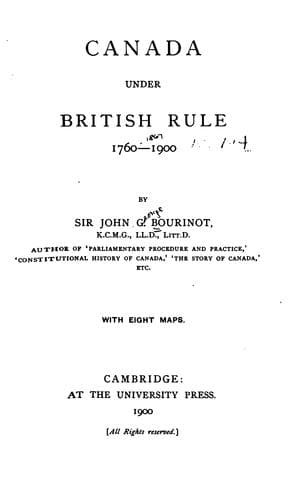
Canada under British Rule 1760-1900Bourinot, John George
History
Canada under British Rule 1760-1900
Bourinot, John George
Canada -- History
Lord Metcalfe's successor was Lord Cathcart, who had served with
distinction in the Peninsular War, and was appointed with a view to
contingencies that might arise out of the dispute between England and
the United States on the Oregon boundary question, to which I shall
refer in another chapter. He pursued a judicious course at a time when
politics were complicated by the fact that the industry and commerce of
the country were seriously deranged by the adoption of free trade in
England, and the consequent removal of duties which had given the
preference in the British market to Canadian wheat, flour and other
products. What aggravated the commercial situation was the fact that the
navigation laws, being still in force, closed the St. Lawrence to
foreign shipping and prevented the extension of trade to other markets
so as to compensate Canadians for the loss of that with the parent
state. Lord Cathcart was recalled within less than a year, when all
prospect of war with the United States had disappeared, and was followed
(1847) by a civil governor, the Earl of Elgin, who was chosen by the
Whig ministry, in which Lord John Russell was prime minister, and Earl
Grey the secretary of state for the colonies. It had dawned upon English
statesmen that the time had come for giving the colonists of British
North America a system of responsible government without such reserves
as had so seriously shackled its beginnings. In all probability they
thought that the free-trade policy of England had momentarily weakened
the ties that had bound the colonies to the parent state, and that it
was advisable to follow up the new commercial policy by removing causes
of public discontent in the province.
Lord Elgin was happily chosen to inaugurate a new era of colonial
self-government. Gifted with a judicial mind and no ordinary amount of
political sagacity, able to originate as well as carry out a
statesmanlike policy, animated, like Lord Durham--whose daughter he had
married--by a sincere desire to give full scope to the aspirations of
the people for self-government, so far as compatible with the supremacy
of the crown, possessed of eloquence which at once charmed and
convinced, Lord Elgin was able to establish on sure foundations the
principles of responsible government, and eventually to leave Canada
with the conviction that no subsequent representative of the crown
could again impair its efficient operation, and convulse the public
mind, as Lord Metcalfe had done. On his arrival he gave his confidence
to the Draper ministry, who were still in office; but shortly afterwards
its ablest member was elevated to the bench, and Mr. Sherwood became
attorney-general and head of a government, chiefly interesting now for
the fact that one of its members was Mr. John Alexander Macdonald, who,
on becoming a member of the assembly in 1844, had commenced a public
career which made him one of the most notable figures in the history of
the colonial empire of England.
Public-domain text, read in full here on John Shaqi.
Reviews
Reviews
No reviews yet
Be the first to share your thoughts on this work.
Elsewhere in the archive
Join the Discussion
Join the discussion
Sign in to leave a comment or review.
Sign InorCreate an account