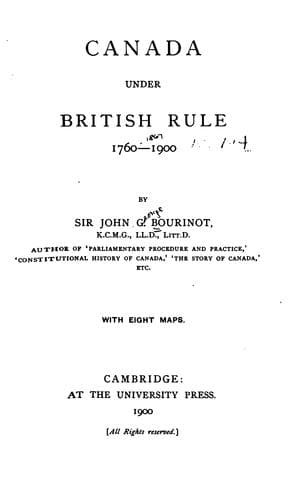
Canada under British Rule 1760-1900Bourinot, John George
History
Canada under British Rule 1760-1900
Bourinot, John George
Canada -- History
In Nova Scotia a despatch from Lord Glenelg brought to a close in 1838
the agitation which had been going on for years for a separation of the
executive from the legislative functions of the legislative council, and
the formation of two distinct bodies in accordance with the existing
English system. In this state paper--the first important step towards
responsible government in the province--the secretary of state, Lord
Glenelg, stated that it was her Majesty's pleasure that neither the
chief justice nor any of his colleagues should sit in the council, that
all the judges should entirely withdraw from all political discussions;
that the assembly's claim to control and appropriate all the revenues
arising in the province should be fully recognised by the government;
that the two councils should be thereafter divided, and that the members
of these bodies should be drawn from different parts of the
province--Halifax previously having obtained all the appointments except
one or two--and selected without reference to distinctions of religious
opinions. Unfortunately for Nova Scotia there was at that time at the
head of the executive a brave, obstinate old soldier, Sir Colin
Campbell, who had petrified ideas on the subject of colonial
administration, and showed no disposition to carry out the obvious
desire of the imperial authorities to give a more popular form to the
government of the province. One of his first official acts was to give
to the Anglican Church a numerical superiority to which it had no valid
claim. As in Upper Canada, at that time, there was a combination or
compact, composed of descendants of English Tories or of the Loyalists
of 1783, who belonged to the Anglican Church, and were opposed to
popular government. Two men were now becoming most prominent in
politics. One of these was Mr. James William Johnston, the son of a
Georgia Loyalist, an able lawyer, gifted with a persuasive tongue which
chimed most harmoniously with the views of Sir Colin. On the other side
was Mr. Joseph Howe, the son of a Loyalist printer of Boston, who had no
such aristocratic connections as Mr. Johnston, and soon became the
dominant influence in the Reform party, which had within its ranks such
able and eloquent men as S.G.W. Archibald, Herbert Huntington, Lawrence
O'Connor Doyle, William and George R. Young, and, very soon, James Boyle
Uniacke. Sir Colin Campbell completely ignored the despatches of Lord
John Russell, which were recognised by Sir John Harvey as conferring "an
improved constitution" upon the colonies. In February, 1840, Mr. Howe
moved a series of resolutions, in which it was emphatically stated that
"no satisfactory settlement of questions before the country could be
obtained until the executive council was remodelled," and that, as then
constituted, "it did not enjoy the confidence of the country." The
motion was carried by a majority of eighteen votes, in a house of
forty-two members, and indeed, so untenable was the position of the
Public-domain text, read in full here on John Shaqi.
Reviews
Reviews
No reviews yet
Be the first to share your thoughts on this work.
Elsewhere in the archive
Join the Discussion
Join the discussion
Sign in to leave a comment or review.
Sign InorCreate an account