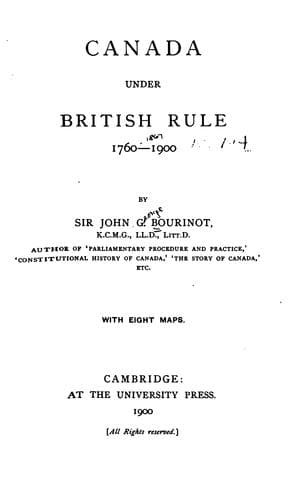
Canada under British Rule 1760-1900Bourinot, John George
History
Canada under British Rule 1760-1900
Bourinot, John George
Canada -- History
executive council that Mr. James Boyle Uniacke, a member of the
government, retired, rather than vote, and subsequently placed his
resignation in the hands of the lieutenant-governor, on the ground that
it was his duty to yield to the opinions of the representative house,
and facilitate the introduction of a better system of government, in
accordance with the well-understood wishes of the people. From that time
Mr. Uniacke became one of Mr. Howe's ablest allies in the struggle for
self-government. Sir Colin, however, would not recede from the attitude
he had assumed, but expressed the opinion, in his reply to the address
of the legislature, that he could not recognise in the despatch of the
colonial secretary of state "any instruction for a fundamental change in
the colonial constitution." The assembly then prayed her Majesty, in a
powerful and temperate address, to recall Sir Colin Campbell. Though
Lord John Russell did not present the address to the Queen, the imperial
government soon afterwards appointed Lord Falkland to succeed Sir Colin
Campbell, whose honesty of purpose had won the respect of all parties.
Lord Falkland was a Whig, a lord of the bedchamber, and married to one
of the Fitzclarences--a daughter of William IV and Mrs. Jordan. He
arrived at Halifax in September, 1840, and his first political act was
in the direction of conciliating the Liberals, who were in the majority
in the assembly. He dismissed--to the disgust of the official
party--four members of the executive who had no seats in either branch
of the legislature, and induced Mr. Howe and Mr. James MacNab to enter
the government, on the understanding that other Liberals would be
brought in according as vacancies occurred, and that the members of the
council should hold their seats only upon the tenure of public
confidence. A dissolution took place, the coalition government was
sustained, and the Liberals came into the assembly with a majority. Mr.
Howe was elected speaker of the assembly, though an executive
councillor--without salary; but he and others began to recognise the
impropriety of one man occupying such positions, and in a later session
a resolution was passed against the continuance of what was really an
un-British and unconstitutional practice. It was also an illustration of
the ignorance that prevailed as to the principles that should guide the
words and acts of a cabinet, that members of the executive, who had
seats in the legislative council, notably Mr. Stewart, stated openly, in
contradiction of the assertions of Mr. Howe and his Liberal colleagues,
that "no change had been made in the constitution of the country, and
that responsible government in a colony was responsible nonsense, and
meant independence." It was at last found necessary to give some sort of
explanation of such extraordinary opinions, to avert a political crisis
in the assembly. Then, to add to the political embarrassment, there was
Public-domain text, read in full here on John Shaqi.
Reviews
Reviews
No reviews yet
Be the first to share your thoughts on this work.
Elsewhere in the archive
Join the Discussion
Join the discussion
Sign in to leave a comment or review.
Sign InorCreate an account