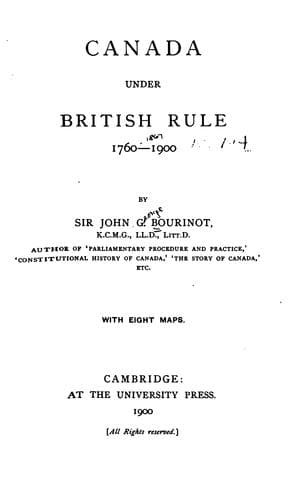
Canada under British Rule 1760-1900Bourinot, John George
History
Canada under British Rule 1760-1900
Bourinot, John George
Canada -- History
In New Brunswick the triumph of responsible government must always be
associated with the name of Lemuel A. Wilmot, the descendant of
a famous United Empire Loyalist stock, afterwards a judge and a
lieutenant-governor of his native province. He was in some respects the
most notable figure, after Joseph Howe and J.W. Johnston, the leaders
of the Liberal and Conservative parties in Nova Scotia, in that famous
body of public men who so long brightened the political life of the
maritime provinces. But neither those two leaders nor their
distinguished compeers, James Boyle Uniacke, William Young, John
Hamilton Gray and Charles Fisher, all names familiar to students of Nova
Scotia and New Brunswick history, surpassed Mr. Wilmot in that magnetic
eloquence which carries an audience off its feet, in versatility of
knowledge, in humorous sarcasm, and in conversational gifts, which made
him a most interesting personality in social life. He impressed his
strong individuality upon his countrymen until the latest hour of his
useful career.
In Prince Edward Island, the name most intimately connected with the
struggle for responsible government is that of George Coles, who,
despite the absence of educational and social advantages in his youth,
eventually triumphed over all obstacles, and occupied a most prominent
position by dint of unconquerable courage and ability to influence the
opinions of the great mass of people.
SECTION 2.--Results of self-government from 1841 to 1864.
The new colonial policy, adopted by the imperial government immediately
after the presentation of Lord Durham's report, had a remarkable effect
upon the political and social development of the British North American
provinces during the quarter of a century that elapsed between the union
of the Canadas in 1841 and the federal union of 1867. In 1841 Mr.
Harrison, provincial secretary of the upper province in the coalition
government formed by Lord Sydenham, brought in a measure which laid the
foundations of the elaborate system of municipal institutions which the
Canadian provinces now enjoy. In 1843 Attorney-General Lafontaine
presented a bill "for better serving the independence of the legislative
assembly of this province," which became law in 1844 and formed the
basis of all subsequent legislation in Canada.
Public-domain text, read in full here on John Shaqi.
Reviews
Reviews
No reviews yet
Be the first to share your thoughts on this work.
Elsewhere in the archive
Join the Discussion
Join the discussion
Sign in to leave a comment or review.
Sign InorCreate an account