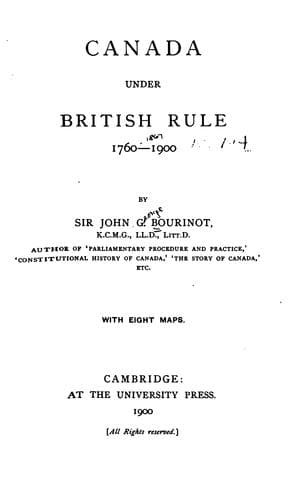
Canada under British Rule 1760-1900Bourinot, John George
History
Canada under British Rule 1760-1900
Bourinot, John George
Canada -- History
The question of the clergy reserves continued for some years after the
union to perplex politicians and harass governments. At last in 1854 the
Hincks government was defeated by a combination of factions, and the
Liberal-Conservative party was formed out of the union of the
Conservatives and the moderate Reformers. Sir Allan MacNab was the
leader of this coalition government, but the most influential member was
Mr. John A. Macdonald, then attorney-general of Upper Canada, whose
first important act was the settlement of the clergy reserves. Reform
ministers had for years evaded the question, and it was now left to a
government, largely composed of men who had been Tories in the early
part of their political career, to yield to the force of public opinion
and take it out of the arena of political agitation by means of
legislation which handed over this property to the municipal
corporations of the province for secular purposes, and at the same time
made a small endowment for the protection of the clergy who had legal
claims on the fund. The same government had also the honour of removing
the old French seigniorial system, recognised to be incompatible with
the modern condition of a country of free government, and injurious to
the agricultural development of the province at large. The question was
practically settled in 1854, when Mr. Drummond, then attorney-general
for Lower Canada, brought in a bill providing for the appointment of a
commission to ascertain the amount of compensation that could be fairly
asked by the seigniors for the cession of their seigniorial rights. The
seigniors, from first to last, received about a million of dollars, and
it also became necessary to revise those old French laws which affected
the land tenure of Lower Canada. Accordingly in 1856 Mr. George Cartier,
attorney-general for Lower Canada in the Taché-Macdonald ministry,
introduced the legislation necessary for the codification of the civil
law. In 1857 Mr. Spence, post-master-general in the same ministry,
brought in a measure to organise the civil service, on whose character
and ability so much depends in the working of parliamentary
institutions. From that day to this the Canadian government has
practically recognised the British principle of retaining public
officers without reference to a change of political administration.
Public-domain text, read in full here on John Shaqi.
Reviews
Reviews
No reviews yet
Be the first to share your thoughts on this work.
Elsewhere in the archive
Join the Discussion
Join the discussion
Sign in to leave a comment or review.
Sign InorCreate an account