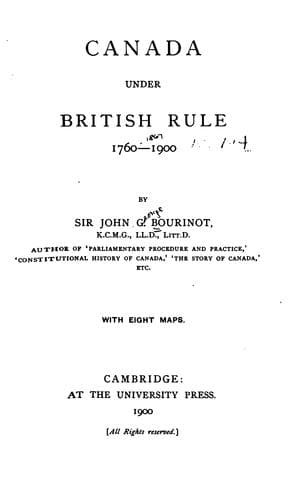
Canada under British Rule 1760-1900Bourinot, John George
History
Canada under British Rule 1760-1900
Bourinot, John George
Canada -- History
The hope of finding a short route to the rich lands of Asia by the St.
Lawrence River and its tributary lakes and streams, influenced French
voyagers and explorers well into the middle of the eighteenth century.
When Cartier stood on Mount Royal and saw the waters of the Ottawa there
must have flashed across his mind the thought that perhaps by this river
would be found that passage to the western sea of which he and other
sailors often dreamed both in earlier and later times. L'Escarbot tells
us that Champlain in his western explorations always hoped to reach Asia
by a Canadian route. He was able, however, long before his death to
make valuable contributions to the geography of Canada. He was the first
Frenchman to ascend the River of the Iroquois, now the Richelieu, and to
see the beautiful lake which still bears his name. In 1615 he found his
way to Georgian Bay by the route of the Ottawa and Mattawa Rivers, Lake
Nipissing and French River. Here he visited the Huron villages which
were situated in the district now known as Simcoe county in the province
of Ontario. Father le Caron, a Recollet, had preceded the French
explorer, and was performing missionary duties among the Indians, who
probably numbered 20,000 in all. This brave priest was the pioneer of an
army of faithful missionaries--mostly of a different order--who lived
for years among the Indians, suffered torture and death, and connected
their names not only with the martyrs of their faith but also with the
explorers of this continent. From this time forward we find the trader
and the priest advancing in the wilderness; sometimes one is first,
sometimes the other.
Champlain accompanied his Indian allies on an expedition against the
Onondagas, one of the five nations who occupied the country immediately
to the south of the upper St. Lawrence and Lake Ontario. The party
reached Lake Ontario by the system of inland navigation which stretches
from Lake Simcoe to the Bay of Quinté. The Onondagas repulsed the
Canadian allies who returned to their settlements, where Champlain
remained during the winter of 1616. It was during this expedition, which
did much to weaken Champlain's prestige among the Indians, that Étienne
Brulé an interpreter, was sent to the Andastes, who were then living
about the headwaters of the Susquehanna, with the hope of bringing them
to the support of the Canadian savages. He was not seen again until
1618, when he returned to Canada with a story, doubtless correct, of
having found himself on the shores of a great lake where there were
mines of copper, probably Lake Superior.
Public-domain text, read in full here on John Shaqi.
Reviews
Reviews
No reviews yet
Be the first to share your thoughts on this work.
Join the Discussion
Join the discussion
Sign in to leave a comment or review.
Sign InorCreate an account