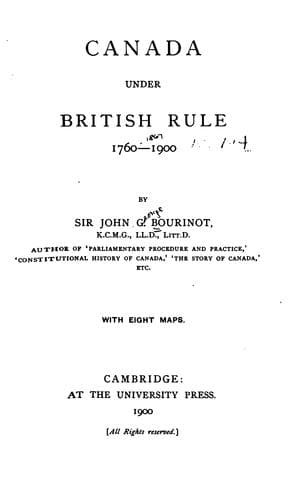
Canada under British Rule 1760-1900Bourinot, John George
History
Canada under British Rule 1760-1900
Bourinot, John George
Canada -- History
discontent then so prevalent in Montreal and other industrial centres,
on account of the commercial policy of Great Britain, which seriously
crippled colonial trade and was the main cause of the creation of a
small party which actually advocated for a short time annexation to the
United States as preferable to the existing state of things. The result
was the removal of the seat of government from Montreal, and the
establishment of a nomadic system of government by which the legislature
met alternately at Toronto and Quebec every five years until Ottawa was
chosen by the Queen as a permanent political capital. Lord Elgin felt
his position keenly, and offered his resignation to the imperial
government, but they refused to entertain it, and his course as a
constitutional governor under such trying circumstances was approved by
parliament.
The material condition of the provinces--especially of Upper Canada,
which now became the first in population and wealth--kept pace with the
rapid progress of the people in self-government. The population of the
five provinces had increased from about 1,500,000, in 1841, to about
3,200,000 when the census was taken in 1861 The greatest increase had
been in the province of Upper Canada, chiefly in consequence of the
large immigration which flowed into the country from Ireland, where the
potato rot had caused wide-spread destitution and misery. The population
of this province had now reached 1,396,091, or nearly 300,000 more than
the population of Lower Canada--an increase which, as I shall show in
the next chapter, had important effects on the political conditions of
the two provinces. The eastern or maritime provinces received but a
small part of the yearly immigration from Europe, and even that was
balanced by an exodus to the United States. Montreal had a population of
100,000, or double that of Quebec, and was now recognised as the
commercial capital of British North America. Toronto had reached 60,000,
and was making more steady progress in population and wealth than any
other city, except Montreal. Towns and villages were springing up with
great rapidity in the midst of the enterprising farming population of
the western province. In Lower Canada the townships showed the energy of
a British people, but the _habitants_ pursued the even tenor of ways
which did not include enterprise and improved methods of agriculture.
Public-domain text, read in full here on John Shaqi.
Reviews
Reviews
No reviews yet
Be the first to share your thoughts on this work.
Elsewhere in the archive
Join the Discussion
Join the discussion
Sign in to leave a comment or review.
Sign InorCreate an account