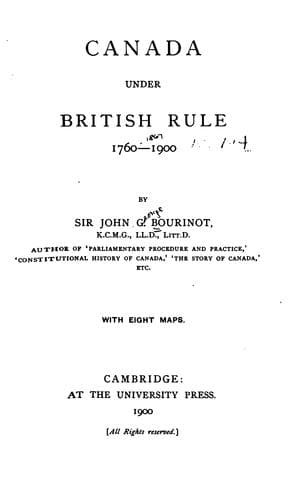
Canada under British Rule 1760-1900Bourinot, John George
History
Canada under British Rule 1760-1900
Bourinot, John George
Canada -- History
The value of the total exports and imports of the provinces reached
$150,000,000 by 1864, or an increase of $100,000,000 in a quarter of a
century. The great bulk of the import trade was with Great Britain and
the United States, but the value of the exports to the United States was
largely in excess of the goods purchased by Great Britain--especially
after 1854, when Lord Elgin arranged a reciprocity treaty with the
United States. Lord Elgin represented Great Britain in the negotiations
at Washington, and the Congress of the United States and the several
legislatures of the Canadian provinces passed the legislation necessary
to give effect to the treaty. Its most important provisions established
free trade between British North America and the United States in
products of the forest, mine, and sea, conceded the navigation of the
St. Lawrence to the Americans, and the use of the canals of Canada on
the same terms as were imposed upon British subjects, gave Canadians the
right to navigate Lake Michigan, and allowed the fishermen of the United
States to fish on the sea-coasts of the British provinces without
regard to distance from the shore, in return for a similar but
relatively worthless privilege on the eastern shores of the republic,
north of the 30th parallel of north latitude. During the thirteen years
the treaty lasted the trade between the two countries rose from over
thirty-three million dollars in 1854 to over eighty million dollars in
1866, when it was repealed by the action of the United States government
itself, for reasons which I shall explain in a later chapter.
The navigation of the St. Lawrence was now made continuous and secure by
the enlargement of the Welland and Lachine canals, and the construction
of the Cornwall, Williamsburgh, and Beauharnois canals. Railways
received their great stimulus during the government of Sir Francis
Hincks, who largely increased the debt of Canada by guaranteeing in 1852
the bonds of the Grand Trunk Railway--a noble, national work, now
extending from Quebec to Lake Michigan, with branches in every
direction, but whose early history was marred by jobbery and
mismanagement, which not only ruined or crippled many of the original
shareholders, but cost Canada eventually twenty-three million dollars.
In 1864 there were two thousand miles of railway working in British
North America, of which the Grand Trunk Railway owned at least one-half.
The railways in the maritime provinces were very insignificant, and all
attempts to obtain the co-operation of the imperial and Canadian
governments for the construction of an Intercolonial Railway through
British American territory failed, despite the energetic efforts of Mr.
Howe to bring it about.
Public-domain text, read in full here on John Shaqi.
Reviews
Reviews
No reviews yet
Be the first to share your thoughts on this work.
Elsewhere in the archive
Join the Discussion
Join the discussion
Sign in to leave a comment or review.
Sign InorCreate an account