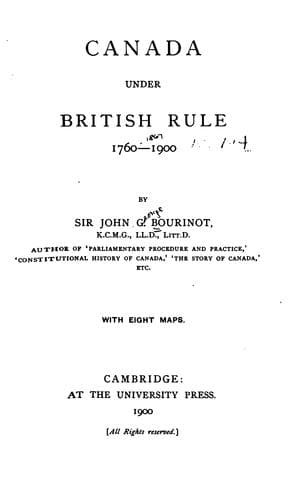
Canada under British Rule 1760-1900Bourinot, John George
History
Canada under British Rule 1760-1900
Bourinot, John George
Canada -- History
A quarter of a century had passed after the union of the Canadas when
the necessities of the provinces of British North America forced them to
a momentous constitutional change, which gave a greater scope to the
statesmanship of their public men, and opened up a wider sphere of
effort to capital and enterprise. In the following chapter I shall show
the nature of the conditions which brought about this union.
CHAPTER VIII.
THE EVOLUTION OF CONFEDERATION (1789--1864).
SECTION 1--The beginnings of confederation.
The idea of a union of the provinces of British North America had been
under discussion for half a century before it reached the domain of
practical statesmanship. The eminent Loyalist, Chief Justice Smith of
Quebec, so early as 1789, in a letter to Lord Dorchester, gave an
outline of a scheme for uniting all the provinces of British North
America "under one general direction." A quarter of a century later
Chief Justice Sewell of Quebec, also a Loyalist, addressed a letter to
the father of the present Queen, the Duke of Kent, in which he urged a
federal union of the isolated provinces. Lord Durham was also of opinion
in 1839 that a legislative union of all the provinces "would at once
decisively settle the question of races," but he did not find it
possible to carry it out at that critical time in the history of the
Canadas.
Some ten years later, at a meeting of prominent public men in Toronto,
known as the British American League, the project of a federal union was
submitted to the favourable consideration of the provinces. In 1854 the
subject was formally brought before the legislature of Nova Scotia by
the Honourable James William Johnston, the able leader of the
Conservative party, and found its most eloquent exposition in the speech
of the Honourable Joseph Howe, one of the fathers of responsible
government. The result of the discussion was the unanimous adoption of a
resolution--the first formally adopted by any provincial
legislature--setting forth that "the union or confederation of the
British provinces, while calculated to perpetuate their connection with
the parent state, will promote their advancement and prosperity,
increase their strength, and influence and elevate their position." Mr.
Howe, on that occasion, expressed himself in favour of a federation of
the empire, of which he was always an earnest advocate until his death.
Public-domain text, read in full here on John Shaqi.
Reviews
Reviews
No reviews yet
Be the first to share your thoughts on this work.
Elsewhere in the archive
Join the Discussion
Join the discussion
Sign in to leave a comment or review.
Sign InorCreate an account