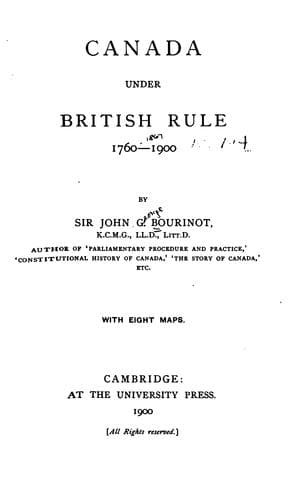
Canada under British Rule 1760-1900Bourinot, John George
History
Canada under British Rule 1760-1900
Bourinot, John George
Canada -- History
In the legislature of Canada Mr., afterwards Sir, Alexander Tilloch Galt
was an able exponent of union, and when he became a member of the
Cartier-Macdonald government in 1858 the question was made a part of the
ministerial policy, and received special mention in the speech of Sir
Edmund Head, the governor-general, at the end of the session. The matter
was brought to the attention of the imperial government on more than one
occasion during these years by delegates from Canada and Nova Scotia,
but no definite conclusion could be reached in view of the fact that the
question had not been taken up generally in the provinces.
The political condition of the Canadas brought about a union much sooner
than was anticipated by its most sanguine promoters. In a despatch
written to the colonial minister by the Canadian delegates,--members of
the Cartier-Macdonald ministry--who visited England in 1858 and laid the
question of union before the government, they represented that "very
grave difficulties now present themselves in conducting the government
of Canada"; that "the progress of population has been more rapid in the
western province, and claims are now made on behalf of its inhabitants
for giving them representation in the legislature in proportion to their
numbers"; that "the result is shown by agitation fraught with great
danger to the peaceful and harmonious working of our constitutional
system, and, consequently, detrimental to the progress of the province"
that "this state of things is yearly becoming worse"; and that "the
Canadian government are impressed with the necessity for seeking such a
mode of dealing with these difficulties as may for ever remove them." In
addition to this expression of opinion on the part of the
representatives of the Conservative government of 1858, the Reformers of
Upper Canada held a large and influential convention at Toronto in
1859, and adopted a resolution in which it was emphatically set forth,
"that the best practicable remedy for the evils now encountered in the
government of Canada is to be found in the formation of two or more
local governments to which shall be committed the control of all matters
of a local and sectional character, and some general authority charged
with such matters as are necessarily common to both sections of the
provinces"--language almost identical with that used by the Quebec
convention six years later in one of its resolutions with respect to the
larger scheme of federation. Mr. George Brown brought this scheme before
the assembly in 1860, but it was rejected by a large majority. At this
time constitutional and political difficulties of a serious nature had
arisen between the French and English speaking sections of the united
Canadian provinces. A large and influential party in Upper Canada had
become deeply dissatisfied with the conditions of the union of 1840,
which maintained equality of representation to the two provinces when
Public-domain text, read in full here on John Shaqi.
Reviews
Reviews
No reviews yet
Be the first to share your thoughts on this work.
Elsewhere in the archive
Join the Discussion
Join the discussion
Sign in to leave a comment or review.
Sign InorCreate an account